You will seldom hear a more vocal defender of capitalism than myself. I tend to be for allowing the market to find its own way, and keeping the government as far away from commerce as possible.
Capitalism works on a few simple principles, which I'm sure I hardly need to recount to AI readers. But the most critical and most fundamental principle is that of incentives. Capitalism assumes that human beings react to incentives. If a system is devised which incentivizes people to work toward socially beneficial goals, then people will naturally perform socially beneficial activities. Hence why people strive to invent new products, devise new production processes, discover new medicines, etc. The dream of striking it rich compels people to pursue all sorts of positive achievements, and mankind has certainly benefited from these pursuits.
In some corners, however, the modern incarnation of Smith's capitalism has become divorced from its core principles. Take Countrywide CEO Angelo Mozilo. He founded the company in 1969 and grew it into one of the largest mortgage underwriters in the U.S. For his success, Mozilo has certainly been well-rewarded over the years.
Today, of course, Countrywide is in serious danger of bankruptcy. The mortgage business is going through a historically difficult period, and if it weren't for a recently announced merger with Bank of America, Countrywide's future as a going concern would be very much in doubt. We could debate the degree to which Mozilo is personally responsible for Countrywide's sudden collapse. But what cannot be denied is that under Mozilo's leadership, Countrywide has destroyed shareholder value over the last 10 years.
And yet Mozilo looks to walk away with a gigantic pay day. According to Bloomberg News, Mozilo could walk away with as much as $84 million assuming the merger goes through. There are some circumstances in which the number could be lower, or even zero. Regardless, the mere possibility that Mozilo would enjoy such a payout creates a perverse incentive.
In any free market system, there will be failures. The dream of riches has to have a downside. With the potential for great success must also come the potential for great failure. Without a penalty for failure, economic agents would be incentivized to take inordinate risks. In private companies, this risk is naturally managed. Small business owners normally must put up their own capital, or borrow against existing assets, such as their homes. Obviously an entrepreneur believes in his new business idea if s/he is willing to mortgage his home and life savings to fund it. Whether the business winds up succeeding or not, the incentives are for the entrepreneur to create value.
Mozilo may have been an entrepreneur once upon a time, but today he's the CEO of a very large public corporation. He knew his company had a large servicing portfolio which would have value to a larger financial institution, regardless of how the rest of his business was performing. He had a long standing relationship with Bank of America, and indeed was supposedly discussing a merger late in 2006. Mozilo could rationally conclude that he'd be able to sell Countrywide, whether to Bank of America or some other institution, in the event Countrywide ran into serious trouble.
With this in mind, what were Mozilo's incentives in recent years? Countrywide's shares had been languishing in the upper 30's for most of 2005, 2006 and early 2007. No doubt Mozilo's personal stock and stock options were not gaining much during this period. Let's be particularly cynical and suppose that Mozilo saw that sub-prime lending had gotten out of hand, and many bad loans were being made. If he was motivated primarily by personal wealth accumulation, then he was probably wise to just keep making those bad loans. After all, the only way Countrywide's share price was going to rise, and create wealth for Mozilo himself, was for the company to grow EPS. In order to do that, they had to keep making loans. Pulling back and tightening credit standards would only slow revenue.
So if Mozilo wanted to grow his personal wealth by pushing the share price higher in the short-term, he would do well to bet heavily on good times. All the while knowing that if it all went to hell, he would just sell the company and collect his exit pay.
Now, we don't actually know what Angelo Mozilo thought about the housing market in 2005 or 2006. We know what he said publicly, but we'll never know what he really believed in his own mind. Perhaps his motivations were noble, and he was merely wrong about the lending business. Even if that's true, the fact that his incentives were otherwise is a serious problem for modern capitalism.
I don't know what the solution is here. Perhaps it is nothing more than having investors put more pressure on compensation committees to create better incentives. Maybe it means that more businesses should stay private. But the problem of perverse incentives is the biggest single problem facing capitalism today. The sub-prime mess will come and go. This is a bigger problem.
Tuesday, January 15, 2008
He could destroy us


Friday, January 11, 2008
Countrywide: I'm saved!
What should we take away from the Countrywide/Bank of America deal?
First, its obviously good for market liquidity that Countrywide won't wind up in bankruptcy. While I think the economy could have handled a Countrywide liquidation, it would have been painful and messy. I'm sure Ben Bernanke is happy about this turn of events. Notice that Fannie Mae and Freddie Mac stock were both up solidly today.
Second, it tells you that Bank of America, at least, is willing to look past the current period into a time when the mortgage business has improved. We all know such a time will come, and the banks which have strong capacity at that time will enjoy strong profits.
Third, this obviously puts Washington Mutual in play. Today WaMu stock opened up about 7%, and their bonds rallied significantly. J.P. Morgan is rumored as the acquisitor, and there is probably only a couple other banks which would even be possibilities. I heard Wells Fargo's name mentioned, and they'd have the capital, but it would be a strange marriage for such a conservative bank. You could also imagine some Mid-West or East Coast bank having interest in WaMu's geographical footprint, but I'm not sure any such banks have the spare capital to absorb WaMu's problem assets. US Bank? Fifth Third? PNC? I doubt it. If I'm Jamie Dimon, even if I'd really like to own WaMu, I wouldn't let BofA's move force my hand. JPM may be the only actual bidder, and WaMu is probably only going to get more desperate.
We should all remember that the credit market will likely improve before the economic picture does. In other words, the credit market is forward looking, and currently spreads indicate that the forward picture is bleak. All it will take for improvement in credit spreads is for conditions to indicate that the future will be somewhat less bleak. I'm seeing too many commentators merely conclude that credit (or stocks) are a bad play simply because the economic picture is poor, which is inadequate analysis. In order to be bearish on a security, you have to assume that conditions will be worse than what's priced in. By the time conditions actually improve, the market will have long since risen.
Wednesday, January 09, 2008
I felt it too
First let me say that I'm not surprised the market rallied strong today. Like I said yesterday, we knew Countrywide was in serious trouble. We've known this for months. Why does the market sell off 200 points on news that was widely expected? With the market taking about 2/3 of it back today, I'd say that sell-off was mostly fast money driven.
That doesn't mean we won't keep going lower. As I discussed the other day, it sure seems like the corporate bond market is set up for a much worse economic outcome than the stock market. Corporate bond spreads are as wide or wider than the last 2 recessions, and yet the stock market valuations seem sanguine on the topic.
But there are some good arguments for the diversion. First of all, the corporate bond universe and the stock market universe are not the same data set. Here are the top 10 investment-grade bond issuers:
General Electric
AT&T
Goldman Sachs
Citigroup
Bank of America
Morgan Stanley
JP Morgan
AIG
Comcast
Merrill Lynch
Here is the top 10 for the S&P 500
Exxon Mobil
General Electric
Microsoft
AT&T
Procter & Gamble
Chevron
Johnson & Johnson
Bank of America
Altria
Pfizer
Within the S&P 500, only GE, AT&T, and Bank of America would appear on both lists. And interestingly, among the top 10 corporate list, only AT&T's stock is closer to its 52 week high than its 52 week low.
So perhaps the divergence in corporate/stock valuations isn't so strange after all. Perhaps the kinds of companies who are large bond issuers are struggling in the stock market as well. Perhaps the kinds of companies which are keeping the stock averages afloat are not big bond issuers: XOM, MSFT, PG, etc.
We may be looking at a sort of weird recession coming up. One where layoffs aren't as bad as some past recessions, but consumer spending drops substantially anyway, because of credit availability. I could see such a recession not being terribly bad for stocks. But financials are right on the forefront of these problems. If that's how it plays out, then the financial-laden corporate bond indices will at best stay wide for a while, even if the stock market improves.
Tuesday, January 08, 2008
Countrywide: Surely he must be dead by now.
This morning, rumors were rampant that Countrywide was to declare bankruptcy sometime this week. The company denied the rumors, saying in an e-mail to major media outlets: "I feel happeeeeeee!"
Here is what I find particularly interesting about today's market.
First, I'm not sure why a potential Countrywide bankruptcy should send the market reeling like this. You know when you and your friends start talking about old movies or old bands? Inevitably someone names some actor or musician and someone says, "I just saw him on TV the other day." And someone else says "He's still alive?" I kind of feel that way about Countrywide.
Second, didn't Countrywide claim they were going to post a profit in 4Q? It sounded doubtful to me when they said it, and its not like things have gotten better in the mortgage market since. Maybe they do manage to pull it off, and if so, that stock will surge. But I sure as hell ain't buying.
Third, here are the bid/ask levels I'm hearing for Countrywide bonds... (by maturity, in dollar price)
2/08 -- 90/92 (floater)
5/08 -- 82/84
4/09 -- 63/65
6/10 -- 61/63
3/11 -- 60.5/62.5
6/12 -- 60.5/62.5
Sounds like the market thinks the recovery is around 60c on the dollar eh?
Friday, January 04, 2008
A disturbance in the Force
I don't comment about the stock market very often, but something isn't right. Take a look at the chart below. The S&P 500 is in red, charted on the left axis. Corporate bond spreads are blue and are inverted on the right hand axis. Thus when the blue line "falls" that should mean the economic picture is deteriorating. From my seat, watching corporate bond spreads widen dramatically over the last 6 months, you'd certainly think recession is on the horizon. In fact, if you draw a horizontal line from where we are now in corporate spreads, you'd see that we've rarely been wider than current levels. We are wider than the worst points during the 1991 recession and 2001 recession, although we did touch a bit wider during 2002.
And yet the stock market is very near all-time highs. I did this graph up through 12/31, so the S&P would be a bit lower. But the basic story would be exactly the same: the stock and bond markets don't agree about where we're going next.
There are some logical reasons why stocks and bonds can diverge. One is that companies are increasing leverage. So equity returns might increase but bond risk rises. That's not happening right now. Financial companies have gone into capital preservation mode, and all companies are finding the bond market quite inhospitable.
I think the economy is going to be weak in 2008, and corporate defaults will surely rise from the ultra low levels of recent years. That being said, corporate bonds look pretty good right now, given that you are getting paid about as much as you ever have for taking credit risk. I don't know what the catalyst for pushing spreads tighter might be (remember the "proving a negative" discussion). It will probably take most of 2008 for spreads to get markedly tighter. And you can bet on spreads being very volatile.
But what's in store for stock holders? I have a hard time making a good argument for stocks to move a lot higher from here. That's not to say I'd advocate anyone selling all their stock portfolio: even if they manage to get out before a sell-off most people don't buy back in time. But looking at the graph above doesn't inspire a lot of confidence.
Anyone care to make a rational argument for why stocks are holding up?
Thursday, January 03, 2008
That name no longer holds any meaning for me
Words have the power to both destroy and heal.
-The Buddha
In thinking about where the economy, Fed, and markets will be going in 2008, I find my thoughts dominated by considerations of liquidity. Readers have heard me use the term "liquidity crisis" or "credit crunch" during 2007, but have rarely (if ever) seen me use "credit crisis" or "solvency crisis." This is purposeful.
Why do I avoid calling this a credit or solvency crisis? Surely I am not here to downplay the problems we're having in residential lending, or even consumer finance in general. I hardly need to enumerate the many problems in consumer lending. I think mortgage foreclosures will break all records in 2008, probably by a long shot. In addition, other types of consumer lending have and will suffer as well. Consumers have been using equity in their homes to help bail them out of other types of debt for many years, but in 2008, this option will be largely unavailable. The result will be weak performance in everything from auto loans to credit cards.
So are there large numbers of insolvent consumers? Sure. Is it going to create a pretty big problem for the economy generally. Yes. Recession? Maybe, just depends on what else goes right or wrong for the economy. Crisis?
I have a hard time with the word crisis here. Maybe I'm hung up on mere semantics. In my mind, a marriage in crisis is one where divorce is an imminent possibility. Not one where the couple just had a big ugly fight. A political crisis is one where the government might collapse. Not where an election is peacefully contested in the courts. To me, that word "crisis" suggests that action must be taken to avert some sort of disaster.
But what's the disaster right now? Consider these simple facts.
1) Most sub-prime ARM loans had a 2 or 3 year fixed-rate period. Therefore the only loans to reset during 2007 were made in 2005. Prime ARM's typically have a 3, 5, or 7 year fixed-rate period.
2) However, the sub-prime delinquencies in 2006 are the real problem. 2005 isn't showing a radically different pattern than past periods.
Notice the much steeper curve displayed in the 2006 vintage, which is like nothing else on the whole board.
3) In 2006, half of all sub-prime purchase mortgages were made with low or no documentation of income.
4) The Case-Shiller home price index is down 6.1% YOY. It registered its first negative reading in January 2007.
5) Conditions that normally precipitate higher delinquencies, namely unemployment, are not currently a problem.
So let's try to reconcile these three facts with how we'd expect a "normal" borrower (prime or sub-prime) under "normal" circumstances to behave. Normal people buy a house because they want to live there. Sure the fact that homes have historically been a positive investment plays a part, but for most people, their house is their home.
There will be some "normal" borrowers looking at negative equity, either now or in the near future. Of course, if that borrower never paid any attention to home prices around him/her, and just kept paying the mortgage bill every month, the negative equity would be of no moment. Remember if a "normal" borrower living in the house decided to walk away, they'd need to find someplace else to live. Given how badly defaulting on your home will mar your credit rating, the "normal" borrower would be loathe to just walk away, even if s/he is significantly underwater, as long as s/he can make the payments.
Plus, there aren't very many "normal" borrowers who would be underwater right now. Using Case-Shiller's data, only borrowers who put less than 6% down and bought their house late in 2006 would have negative equity currently. Perhaps borrowers in the "boom then bust" areas are more likely to be in a negative equity position. But still, we're talking about a relatively small number of "normal" borrowers.
So where are all these delinquencies coming from? And what does that say about what 2008 will hold?
First I think you have people who are delinquent for "normal" reasons. They've lost their job, they've gotten sick, they gambled away their starship, whatever. This caused them to rack up some credit card debt. In the past this borrower was able to tap home equity and get out of trouble. Unfortunately, the borrower isn't able to do this currently, both because lending conditions are very tight and because the borrower might not have adequate equity.
Like I said, this group probably isn't the lions share of the marginal delinquencies, because we aren't seeing macro events which would cause these events to happen on a large scale.
No, I think the bigger problem is investors. If you buy a property solely for investment purposes, then all the rules of a "normal" investor are out the window. I think many investors bought properties with little to no down payment. Investors were more likely to get involved in hot neighborhoods, where prices have probably been hit hardest lately.
Many investors just don't have the option of sitting on the property. If you bought an investment property but also had a house you are living in, you may not be able to afford two mortgages indefinitely. And you probably can't rent the place for the same amount as your mortgage payment. It might be that you can save your actual home by just walking away from your investment property. For the investor, the jingle mail option may just be the best of a bad situation.
So back to the "crisis" question. It is these speculators who are insolvent. So what we have are people who speculated in houses and lost. We have are banks who lent to the a fore mentioned speculators and have lost too. Bear in mind, these banks are the ones who agreed to limited documentation of income (perhaps so the speculator could claim this would be his/her primary residence?) or minimal down payments.
What we also have are brokerage firms who warehoused bonds backed by these speculation loans, assuming they'd be able to unload them into a CDO. They've lost too. We have banks buying AAA-rated CDO^2, who never asked why CDO^2 spreads were so much wider than other AAA product. Guess what? They've lost too. We have money markets buying securities they didn't understand. Losers. We have hedge funds who took already leveraged CDO and ABS product, and leveraged it some more! Loo--oo--oooooooser!
All this isn't a crisis. Its how the credit cycle works. When credit becomes too easy, bad loans get made. People get hurt. But that's the way of the world. You move on.
Where a crisis could develop is when the innocent are hurt just because capital becomes tight. Where a good borrower can't get a mortgage loan. Where a solid commercial real estate project can't roll over its bridge loan because banks are short on capital. That's where the real crisis can get going. Foreclosures happen that didn't need to happen, driving the price of assets lower. Lenders start taking losses on good loans, and suddenly are unwilling to lend to anyone. Investors struggle to value assets, not because of unknown losses, but because of unknown liquidity. Bids disappear.
That's a crisis.
Wednesday, January 02, 2008
How municipal bond insurance works
(Alternative title: 10,000?!?!)
The sub-prime woes of 2007 have thrust bond insurers into the spotlight, and for the first time really calling into question the utility of municipal bond insurance. I have received a number of e-mails and comments from municipal bond investors expressing concern over the quality of their portfolio. I thought it would therefore be useful to discuss how muni insurance works, and what the decline of any municipal insurer would mean for municipal credit quality.
Municipal?
First a couple notes about municipal bonds. The term "municipal" is a bit of a misnomer, since any tax-exempt bond is generally considered a "municipal." That includes not only states, counties, and cities, but also government-related entities (such as a public university) and non-profit organizations (such as a hospital or private university). States, cities, counties and school district bonds which have pledged their full taxing power to bond holders are called general obligation. All other issues are called revenue bonds. Readers should note that governmental authorities are often not funded out of the state's general revenue, but out of their own revenue stream. For example, the Maryland Transportation Authority's revenues come from tolls and the state fuel tax. It would be theoretically possible for the Transportation Authority to be bankrupt without the state defaulting on anything.
"Zero Loss"
Municipal default rates are far lower than their corporate counterparts, as the following chart from Moody's shows.
In fact, there has been only one General Obligation issuer rated by Moody's which defaulted since 1970, and in that case, the default was cured (paid in full) 15 days later.
Certain revenue issues are considered so fundamental to the operation of the government that the odds are low that any government would allow the issuer to fail. These bonds are called essential service bonds and bonds within this category also have a very low default rate. There is no one definition of essential services, but typically issues for public universities, primary/secondary schools, water and sewer utilities, and state highway authorities fall within this category.
The Aaa-rated insurers, MBIA, AMBAC, FSA, FGIC, XLCA, Assured Guaranty, and CIFG, have historically insured mostly general obligation and essential service bonds. MBIA has a self-described "zero loss" underwriting standard, so concentrating their insurance activities within a very low default risk arena seems to fit.
The Aaa insurers have and do insure other issues, like hospitals or industrial development bonds. But the insurers charge much more for these kinds of projects, and often demand some hefty protection in terms of covenants or pledges. In past talks with people working for insurers, my understanding is that they believe every bond they insure has risk equivalent to a Aa-rated corporate bond or better.
"We could almost buy our own ship for that!"
Now you may be wondering if insurers are underwriting to a zero loss, why do municipal buyers bother with insurance? Well, municipal buyers tend to be very high quality focused. In essence, the municipal investor wants to take advantage of the tax-exemption, s/he isn't real interested in credit risk. So having bond insurance allows the muni buyer to do minimal credit research (if any) before buying a bond. This facilitates liquidity in the muni market, because Street traders can put a reasonable bid on any insured bond without having particular knowledge of the underlying credit.
Who buys the insurance?
Municipals are initially sold to the public through underwriters just like stocks or corporate bonds. The underwriter may be selected in advance (called a negotiated deal) or by competitive bid (called a competitive deal. No really!). In a negotiated deal, the underwriter and issuer jointly decide whether to insure the bond or not. They will solicit bids from various insurers and determine whether the cost of insuring the bond lowers the rate on the bond enough to make insurance worth it. In a competitive deal, the underwriter presents a bid to the issuer, which is an all-in cost of the bonds, including issuance costs and interest rate. If the bonds are to be insured, that's just part of the issuance cost.
In a competitive deal, its often the case that the insurer is contacted about insurance only a couple hours before the bids are due. In the case of essential service bonds with an explicit rating or that the insurer has insured before, the turnaround time on an insurance bid can be mere minutes.
Technically the insurance is bought by investors, as the cost of insurance is taken out the proceeds of the bond sale. It is almost always paid as a lump sum to the insurer when the bond sale settles.
How much does the insurance cost?
Insurance may cost less than 10 basis points as a percentage of the bond deal its an essential service deal with a strong underlying rating. Riskier deals obviously cost more. This highlights why most investors wanted the insurance: it is usually so cheap, why not buy the insurance?
Here it might be helpful to think of municipal insurance the same way you think of homeowners insurance. Everyone knows that if you simply look at the odds of making a claim vs. the cost of insurance, buying insurance is a net negative for the home owner. However, most homeowners would be bankrupt in the event that their home was destroyed, as they would not be able to repay their mortgage. The negative ramifications of this relatively low probability event are so high that home owners willingly buy insurance, knowing its a net negative proposition. Municipal insurance is the same way.
What percentage of municipal bonds are insured?
About 45% of investment-grade munis are insured. In practice, there are two major types of bonds that don't get insured. First is lower-rated issuers, which the insurers either won't insure or for which the price is too high. This would be your A or Baa-rated hospitals, nursing homes, development projects, etc. Sometimes these kinds of issues are insured, and sometimes they are not. If they are not, buyer beware. An insurer probably wanted to charge an arm and a leg because they viewed the bond as risky.
Second is higher-rated issuers. Obviously "natural" Aaa-rated issuers don't need insurance. But also many Aa-rated issuers, especially large and well-known issuers, don't benefit much from insurance. For example, the State of Florida is Aa-rated, but rarely buys insurance for their issues because their credit is well-known. Conversely a school district in rural Kansas would probably pay for the insurance, even if they would have a Aa-rating on their own, because buyers are not familiar with the credit.
Do insured bonds trade with the same yield as other Aaa-rated bonds?
No. Natural Aaa-rated issues typically yield about 10bps less than insured issues. Historically, insured issues trade very similarly to strong Aa-rated issues. Hence why larger, well-known Aa issuers usually don't get insurance.
So what happens if an insured bond defaults?
The insurance policies state that the insurer will pay timely principal and interest. Translated, this means that the insurer will make all payments as though nothing happened to the underlying issuer.
So what happens if an insurer defaults?
Nothing changes about the municipal issuer's obligations to pay investors. Remember that the cost of insurance was paid up front. There are no on-going payments, so neither the investor nor the issuer would have any claim against the insurer so long as the issuer remained solvent.
What about the ratings? What is an underlying rating?
Even when a bond is going to be issued with insurance, it is common for issuers to get a rating "on their own." This rating is called an underlying rating.
So if the insurer were to be downgraded, the bond's rating would revert to the greater of the insurer's rating or the underlying rating.
Why not get an underlying rating?
S&P and Moody's charge issuers an exorbitant fee for a rating, so often smaller issuers or issues done for a one-off project don't get underlying ratings. Sometimes issuers choose to buy the insurance because insurance was cheaper than getting a rating.
A good example of a one-off project would be a deal I bought a while back for a new electrical substation at Georgia Tech University. GA Tech structured the deal such that it was off-balance sheet: they issued the bonds under their Foundation and then the Foundation leased the substation back to the university. A deal like that is unlikely to get an underlying rating for two reasons. First, its a one-time project, so paying for the rating would not have on-going benefits. Second, GA Tech is well known and the substation is obviously extremely important to the University. Investors logically assumed the rating would be about the same at the University's rating.
Up until recently, another category of issuers who did not get underlyings would be those that expected a Baa underlying. It was often assumed that having a Baa underlying would not improve the rate investors would pay, especially in the case of a general obligation issue. Now that is changing, as investors don't want to wind up with a non-rated bond in the event that the insurer is out of the picture.
What about trading levels in FGIC and XLCA bonds?
I think until either is downgraded, you won't see much trade. And it will depend greatly on the underlying rating.
What's the future for insurance?
I believe that insurance will continue to be a major part of the municipal market. I expect two major changes:

- Somewhat fewer bonds will come insured, especially if they were Aa-rated on their own.
- Very few issues will come with no underlying, even if its a Baa underlying. Many investors are restricted from owning non-rated bonds, so therefore even a weak underlying would allow the investor to continue to hold the bond.
But the basic advantage of owning insurance hasn't fundamentally changed.
Saturday, December 29, 2007
You're wrong Assured Guaranty. You have that power too.
The answer to the first question is that its great news. See below.
The answer to the second question is that its great news for some and terrible news for others. Remember that it was often speculated that Berkshire could be a source of capital for the likes of AMBAC, MBIA or FGIC. I myself wrote the following in November:
Berkshire Hathaway has expressed interest in the muni insurance business. I'm sure that if Berkshire put, say, $1 billion into AMBAC, then AMBAC could subsequently do a couple preferred offerings. They'd be expensive, but with Warren Buffett already on board, I think they could get it sold.
Now Buffet won't be on board, so you can forget all that. Its possible BHAC sells some reinsurance to existing muni bond insurers, but that won't inspire confidence in the overall concern like a direct investment would have. I'd therefore put the odds of an eventual downgrade of FGIC as very high, AMBAC and MBIA as moderate. S&P and Moody's are currently satisfied with both MBIA and AMBAC's capital position, which means that any downgrade of these two is likely 6-12 months away if it happens. I believe both MBIA and AMBAC will need more capital, so the moderate odds of a downgrade is based on the odds of them raising more capital. FGIC on the other hand needs capital pronto and I don't know where its going to come from.
I'm skeptical that any of these three can remain a going concern without a AAA rating. I'd suspect they go into runoff. MBIA stock was down nearly 16% today, AMBAC down nearly 14%.
Meanwhile, Assured Guaranty was also lower today by about 4%. The market is reading the Buffett news all wrong by punishing AGO. See, AGO is kind of like the C3-PO of bond insurance. Not especially better than the next protocol droid, but happened to get stolen by the right Jawas at the right time. Now AGO is right in the middle of saving the entire galaxy from the Evil CDO Empire! I guess Buffett is kind of like Luke in this metaphor? Or maybe Obi Wan? I digress.
AGO has benefited from a ton of free press in the last 6 months. As problems with the larger, more established MBIA, FGIC, and AMBAC became apparent, both the ratings agencies and Street firms starting publishing regular reports on all bond insurers. This thrust little Assured into the mainstream consciousness. Suddenly the "reputation" barrier to entry in the municipal insurance business had been smashed into who knows what.
The only risk AGO stock holders face is the possibility that municipal bond insurance declines as a concept. That bond buyers are no longer willing to pay for extra protection on AA-rated school districts and A-rated sewer systems. The fact is that the history of defaults on these types of credits is slim indeed, which is exactly why the municipal insurance business is so profitable. Classically, muni buyers liked insurance because it prevented them from having to do any credit research. So the question is, will investor laziness trump the fear created by current insurer troubles?
I believe the entry of Buffet's firm solidifies the laziness argument. Now municipal buyers can say that we have three solid insurers without any significant structured finance holdings: FSA, AGO, and now BHAC. That's enough insurers to diversify a portfolio reasonably. We can also dismiss FGIC and whomever else winds up going down as insurers who made bad decisions. Not that insurance is a bad business or a bad concept.
I've been around the muni market long enough to know that these people like the status quo. Even more so that other markets. They want to believe in insurance. They want to keep buying insured bonds without thinking about it. They won't need a lot of convincing that throwing FSA and AGO out with the FGIC bathwater is a bad idea. Its what they want to believe anyway.
So back to AGO stock. Its really the best pure-play muni insurer going. Current its trading around 1.1x book. MBIA and AMBAC had been trading more like 1.3x prior to the credit crunch. But that's not the real reason to own AGO. Assured is going to rapidly rise from also-ran to major player in municipal bond insurance. Municipal issuance is going through a bit of a lull here, but after the new year, we're going to see muni issuance ramp back up. Issuers are going to be looking for insurance, and they ain't going to be calling MBIA. Assured, FSA and Berkshire are going to dominate municipal insurance in 2008. This should allow Assured to grow their book value just as fast as they can get capital to grow it. This will also create improved pricing power, which is the reason Buffett gave for making an entry into the muni market. So you may argue that AGO should trade at a higher multiple of book value than MBI or ABK did in years past.
AGO's stock may be rocky, especially if any of the problem 3 wind up in run-off in 2008. But still, as a long-term investor, I'd be happy to ride that out. AGO has a great model and a great opportunity. In time, they will learn to use this power. And I want to be in on the ride.
Disclosure: I own many insured munis, and am personally long AGO stock.
Monday, December 24, 2007
What is a Tender Option Bond (TOB)?
(Alternative title for long-time readers: There's a meteorite that hit the ground near here. I want to check it out. It won't take long.)
A tender-option bond (from now on TOB) is the municipal bond market's answer to the classic borrow short and invest long. As with many types of leveraged strategies, this one has been getting hit very hard in 2007. It also has some disturbing parallels with the SIV problem which has rocked the money markets.
What is it?
First, here is what a TOB is. You start out with a long-term tax-exempt municipal bond, usually highly rated. Let's say you buy it at par with a 4.5% coupon. 30-year tax-exempt munis are widely available at that price right now.
Then you sell senior notes to some other investor with your long-term muni pledged as collateral. The amount is somewhat less than the value of the collateral pledged. The senior notes have the same maturity as your pledged collateral, but the interest rate floats every seven days. Typically the floating rate is set by a dealer firm (called the "remarketing agent") based on whatever rate will clear the market. The senior note holders also get a put option, also called a tender option. The senior note holders can put their bonds back to the issuer at par at any time with settlement on the next reset date.
If you are familiar with municipal floaters, you know this is a very common structure. It goes by the name VRDO (Variable Rate Demand Obligation) or VRDN (N=Note) or VRDB (B=Bond). It is used by normal issuers who want variable rate debt as well as TOBs. The idea that the bonds would always be puttable at par probably sounds funny to some readers, so think about it this way. It really just like a revolving CP program where the issuer retains the same amount outstanding all the time. While technically in a CP program, the old CP matures with proceeds from the new CP, as long as the capital markets are fully operational, the CP issuer effectively just resets his interest rate.
So back to the TOB. You remember the size of the senior issue was less than the size of the collateral pledged, which leaves us with some residual. That is sold to junior note holders, who in essence have leveraged exposure to the original municipal bond.
These programs can be structured as single name deals, where a single long-term muni has been pledged vs. a single senior VRDO. Or it can be structured where there is a pool of long-term munis pledged against a larger senior VRDO. From a pure safety perspective, the senior holders would obviously prefer the pool, but there are legitimate tax concerned about the pooling structure. Legally, in order for the tax-exempt status of a bond to pass through any kind of structured product, the credit risk of the municipal has to be retained by the investor. Thus the senior/subordinate structure of the TOB can get sticky, especially if its pooled. Some tax attorneys argue that when you pool this kind of program, the senior holders are not actually taking risk on all the municipals in the pool, since its usually the case that several could default without senior holders getting hurt. This senior/subordinate concept is not unlike a CDO structure in terms of how the senior notes are protected.
VRDOs are normally backed by some sort of credit enhancement, which is different than the classic bond insurance. In the case of a VRDO, the backing is normally from a bank, which can come in various forms: a letter of credit, a stand-by purchase agreement, or just a liquidity facility. All of these have similar functions for the investor: it ensures that if investors want to put their bonds back, that someone with capital is there to buy them.
The junior notes are most likely held by a hedge fund. There are many hedge fund for which this is their only strategy, and they spend most of their day creating these TOB structures. Since the junior notes have considerable interest rate risk, the hedge fund generally cooks up some means of hedging this risk. Unfortunately, the world of municipal derivatives is pretty murky, so often the hedge fund winds up using LIBOR swaps or some such as its hedge. This introduces the risk that taxable bond rates move differently than municipal bond rates.
In addition, long-term municipal bonds are usually callable by the issuer starting in the 10th year. The option risk inherent in the municipal makes hedging with non-callable taxable instruments like swaps a real challenge.
TOBs are generally created using AAA municipals as collateral. This has to do with the desires of both the senior and junior note holders. The senior holders, usually money markets, generally want very highly rated securities. Ratings agencies will generally rate the TOB senior piece the same as the underlying collateral. The hedge fund buying the junior piece also wants to avoid credit problems. The arbitrage of a TOB is all about the slope between short-term and long-term bonds. Introducing credit risk merely complicates an essentially simple arbitrage.
Now here is where the problems start...
Current Troubles
Up until now, finding AAA-rated long-term munis was easy, because so many munis were insured by AAA-rated monolines. I believe its around 40% of all municipal issues are insured. But now we're in a world where that AAA rating is imperiled. This has caused the municipal bond market to decouple from the taxable bond market, perhaps not entirely, but to some degree. Whereas historically municipals tend to trade around 80% of Treasury rates, currently the number is above 90%. Long-term municipals are widely available at or slightly above the 30-year Treasury rate.
This means two things for TOBs. First, money market funds are increasingly unwilling to hold short-term TOB debt. Makes sense right? If you were running a muni money market fund, and you could get out of any TOB debt at par right now, wouldn't you? You know that there is a decent chance some of the TOB bonds are about to be downgraded. You also know that the guy across the hall who ran your prime money market fund just got fired over the whole SIV thing. I'd dump those TOB bonds as fast as I could.
Second, the TOB hedge fund's hedge position isn't working. Municipal yields are not moving with taxable yields and this is creating big losses for the TOB. And we know what happens when hedge funds take losses: investors start pulling out. So you've seen TOB programs having to force liquidate bonds.
Bad news. TOBs represent 8% of the total municipal bonds market, or about $200 billion. The muni market isn't known for its liquidity, so if you have a large number of bonds being dumped on the secondary market, the whole market cheapens up. This is exacerbating any credit concerns market participants might be having.
Parallels with SIVs
The parallel with the SIV problem is hard to miss. Money market participants eschew the debt. Vehicle can't roll over. Winds up liquidating into an illiquid market. Exacerbates an already tenuous credit environment.
The good news is that unlike SIVs, the credit quality of municipals remains very strong. While SIVs were involved in the CDO and sub-prime markets, where there has been unquestionable and material deterioration, municipals don't really have this problem. Property tax collections may wane a bit, but the odds of this rising to a level where any cash flow to bond holders is ultimately impaired is remote. The only real problem in munis are the bond insurers. Even if one or more bond insurers were to disappear, the downgrade in most municipals would be from AAA to AA or A. Not good, but not the end of the world.
The bad news is that the bank credit enhancers may wind up owning the TOB bonds. See, if the hedge fund which is operating the TOB program can't make good on the short-term debt, perhaps because it can't liquidate all its long-term bonds and hedges at less than 100%, the bank will probably wind up possessing the underlying bonds. Again, this won't turn out like the SIV problem, where bank sponsors of SIVs are taking bonds onto their balance sheets at steep discounts. But still, cash-strapped banks are likely to just blow out the muni positions, creating more of a supply problem in the long-end of the muni curve.
Sell my Munis? Sell my muni money market?
I'm surprised to find you squeamish, monsieur, that is not your reputation. I think munis are a screaming buy for long-term holders. You are rarely going to get the chance to buy long-term munis at prices about equal to Treasuries. That isn't to say this is the absolute bottom, but I think as we finally resolve the bond insurer issue (one way or another) municipal buyers will come back in. Remember, there is no good substitute for municipals. They are the only tax-free game in town.
Friday, December 21, 2007
I want proof, not leads
I'm contacted by new bloggers a fair amount, and I honestly at least check out the sites I'm sent. Unfortunately, I don't have as much time for reading as I'd like, so the list of blogs I read regularly is quite small. But still, I appreciate the e-mails from fellow bloggers. Keep 'em coming.
There is a piece on this new blog (which is trying to create a sort of independent stock research center where the reports are written by users) about iStar Financial. Fair disclosure, I'm considering a debt investment in iStar.
Anyway, toward the end of the report, the author goes into a bit about how financial stocks are in the unenviable position of proving a negative. I want to explore this idea a bit more.
No one knows how far the residential lending contagion will spread. Are banks and brokers just taking a "big bath" right now, and writedowns are near an end? Or are there one or more large financials headed for bankruptcy? What companies may have invested in sub-prime related securities, from CDOs to SIVs? Who has counter-party risk with shaky partners? What companies are so reliant on securitization that they will face a liquidity crunch? Who may need to come to the debt markets now and pay unusually wide spreads and what impact will that have on earnings?
Taking it a step further, how much will losses in home values impact consumer spending? What companies may be over-leveraged to the mortgage-equity withdrawal trend? Or consumer credit in general? What companies will be facing higher defaults from non-residential lending because easy credit has previously kept consumer loss rates low?
We are all struggling with these questions. I think I know the answer to some of these, but I must concede that my confidence level in any particular outcome is low. I think a lot of actual traders are struggling with the same problem. We know there is a lot of bad news priced into securities, but we also know there is bad news to come. And we can't be sure from where the bad news will hit.
So you take a company like iStar Financial. They are a commercial real estate lender. Now perhaps you have a "classic" reason to be bearish on iStar, such as you are bearish on commercial real estate. Fair enough. But in today's market, a legitimate concern is whether someone like iStar can weather a period where it is difficult to raise capital. And if you assume they can survive such a period, what would their earnings look like?
But there is nothing iStar can do to prove it can survive a serious credit crunch except to go ahead and survive it. Investors are in essence saying "Prove to us you won't have a problem in this environment." But no company can prove any such thing, because we don't know how much worse the credit crunch might get. Or what other types of securities or loan-types might be hit next.
A myriad of other financial stocks (and bonds) are suffering through the same thing. We know that some are particularly vulnerable. Washington Mutual, Countrywide, AMBAC, etc. But there is a large number of companies that haven't had any particular residential lending-related problem. There are other companies that have had some problems, but that there isn't any particular reason to believe there will be more. And yet because the market is asking these companies to prove a negative, the stocks (and bonds) have been beaten up pretty badly. As long as a sub-prime or contagion losses could crop up, investors are going to be highly skeptical.
One could say this is the nature of a bear market. Investors become more focused on their fears and less on their greed. Sometimes the innocent get punished. Sometimes the not-so-innocent are punished before their crime is fully revealed.
So if you are considering investment in any financial company's securities, bear this in mind. This thing is hitting all aspects of finance. On one had, we have real losses on mortgage loans. On the other hand, we have a serious liquidity crunch. On our left foot, we have much wider credit spreads. There is no such thing as a financial company for whom none of that matters. Financials, by their nature, almost always take credit risk of some kind, and need funding of some kind. There are many companies being unfairly beat up right now, but which are the innocents and which are the not-so-innocent not yet revealed is a tough call.
Even if you are right about the particular company you are looking at, the fear of the unknown will continue to dominate markets until the pace of bad news slows down. Put another way, when a company is being asked to prove a negative, there is no catalyst that will accomplish this. Investing intelligently in a market like this requires patience, stamina, and constant re-evaluation.
Clumsy and Random Thoughts
I was out of the office yesterday, finishing up some Christmas shopping. Here are a few quick thoughts.
- MBIA's disclosure surprises me. Not what they've disclosed, but how it happened. First of all, why not reveal all this stuff when you made the pact with Warburg? Second, why does Fitch put them on negative watch, as though MBIA's CDO^2 portfolio was news to Fitch? How could Fitch even begin to analyze MBIA's credit rating without a full accounting of their CDO^2 portfolio? Maybe its just a coincidence, but it seems odd. Anyway, readers of AI know I believe the bond insurers will need more capital to keep their AAA/Aaa rating anyway.
- The Term-Auction Facility's first auction went off pretty well, with a stop out rate of 4.65%. That's below the discount rate and below 1-month LIBOR by about 30bps. I'll note that's the kind of rate Freddie Mac and Fannie Mae get on short-term borrowings. I read this as saying that there weren't many banks out there desperate to borrow over year-end, and in essence the bids they got were at lower interest rates than where big bank CP is. That's not consistent with a liquidity crunch, and makes me wonder whether we really will see the Fed cut as deep as I had previously thought.
- According to multiple sources on the Street, there has been a ton of year-end buying of industrial corporates. Spreads haven't moved dramatically tighter, probably because there bid/ask levels were a little fuzzy anyway going into this week. Dunno if it follows through into January or is merely window dressing. Its a lot easier to be bullish on industrials, both IG and BIG, than financials right now.
Thursday, December 20, 2007
Hokey Religions
When I started college, I wanted to be in politics. I was already of a Libertarian mindset, and had it in my mind that I could change the world. I picked economics as a major to learn about setting policy, not because I wanted to get into investments. Suffice to say I've fallen from the true faith and am now little more than a money grubbing trader.
Anyway, early in my college career I wrote a paper on budget deficits. Having a Libertarian bias to begin with, I set out to find sources which would conclude that budget deficits were evil. Lawyering? Hey, I wanted to get into politics at the time. Cut me some slack.
Lo and behold, I had no trouble finding academic papers suggesting that the ever growing budget deficit would eventually cause financial Armageddon. I slapped a series of quotes and charts into my own paper, called it research, turned it in and got an A. I became convinced that balancing the budget should be priority #1, and that politicians were tax and spending us straight to disaster.
As I moved further in my studies of economics, I realized that something like the budget deficit was unlikely to have a major impact on the economy in any given year. And as I became more involved in projects involving near-term economic projections, variables like the size of the national debt never worked as predictors. Despite all those sensationalist papers I read at the begining of my academic career, the large national debt was something more likely to slowly eat away at economic potential, and less likely to cause some sudden economic crisis.
If I wanted to get better at forecasting, I had to forget about what I thought should be done and focus on the effect of what would be done. So while politically I'd really like to see the budget balanced, the reality is that we're going to have a deficit this year. I feel my time is better spent considering whether this matters for near-term economic performance rather than railing against the deficit.
So where am I going with all this? Lately we've had a lot of proposals from various sources to alleviate the sub-prime crisis and related contagion. FHA Secure, Hope Now Alliance, Fed rate cuts, the term-auction facility, etc. Politically, if it were put to a referendum, I'd vote against all of it. Well, maybe not the Hope Now which was really just a coalition of banks. But the rest of it, if I were dictator of the world, I wouldn't do anything. I'd make sure the nations depositors knew that the FDIC was well funded and deposits were safe. The most I'd consider doing is increasing the FDIC insured limit at a bank. Other than that, I'd be for letting the chips fall where they may.
I'd privatize Fannie Mae and Freddie Mac. I'd figure out some way of phasing this in as to not cause all kinds of liquidity problems, but we'd start moving in that direction today.
Even the Fed cuts. If I were dictator of America, I'd mandate the Fed be given an inflation target and give the job of banking regulation to some other office. If the inflation target indicated lower rates, fine, but otherwise I'd rather see the Fed stay out of the economy.
But guess what? I'm not dictator of America, and it doesn't look like I'm going to be any time soon. So what I want to see happen is irrelevant. So rather than spend a lot of time thinking about the policies I want, I work on what the impact of policies will be. So while I hated the FHA Secure plan, I have to admit that it will prevent some borrowers from going into foreclosure. The housing market will be more stable, perhaps only to a very small extent, with FHA Secure than without it.
Same with the Fed providing liquidity. I try to think about it as if I'm Ben Bernanke. I've read a lot of his academic work, so I have some basis for how he's thinking. I've also read a ton of papers written by other Fed economists. As a group, they believe in monetarism generally with a neo-Keynesian streak. They belive that while inflation is their #1 enemy, liquidity crunches can cause big problems. They believe that providing liquidity when liquidity is dear can increase stability.
Now I might believe that the Fed contributes to instability at times, forcing them to react in the future. This may be exactly what's happening now, with the Fed having to deal with the consequences of keeping rates too low for too long. Here again, though, it doesn't help me make good forecasts to harp on the mistakes the Fed made in 2003-2005. I mean, its an interesting conversation, but entirely irrelevant to projecting what the Fed is going to do in 2008.
So I say put your personal philosophy aside when making forecasts.
Tuesday, December 18, 2007
Housing prices: We're in for it as it is!
I have been working for several weeks on a model for what the fundamentally correct price for homes. I'll tell you right off the bat that I'm not happy at all with the results.
First let's think about what factors would influence the demand curve for homes. Thinking back to micro 101, demand is a 4-part function.
- Price of the good.
- Price of other (related) goods. Here I think we're talking mostly about rental housing and the price of financing.
- Income.
- Tastes and Preferences. Increasing or decreasing demand due to speculation would fall into this category.
The last 3 items form the demand curve, where the first causes movements along the demand curve. Basic price theory.
The supply of homes is a function of the marginal cost vs. marginal expected revenue. In thinking about where home prices are headed, we know supply from builders is going to be much lower in coming quarters. The variable is supply from foreclosures.
Anyway, let's start with some simple estimates of demand. Here is personal income versus OFHEO's home price index. Both are normalized to start at 1 in 1997. 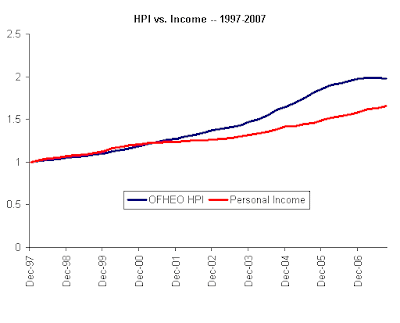 The gap between income gains and home price appreciation is 16%. So if you believe that home prices and income should rise at the same pace, then home prices need to fall 16%.
This kind of analysis is intuitively appealing. Its simple and logical. People can't afford to pay more and more for homes unless their income is rising as well. So you'd think that home prices should track income gains pretty well.
Unfortunately, the analysis doesn't hold up for various time frames. If we look back 15 years... Homes look only about 7% over valued. And if we look back 20 years...

Homes are actually about 7% under valued! Given that interest rates are generally lower than they were in the 1980's and most of the early 90's, this would seem to imply that home affordability is better today than in 1987 or 1992. So you can't say that homes prices need to fall now because home affordability is worse than, say, in 2000 unless you can explain why 2000 is the right comparison date. Why not 2002? Or 1991? Or 1823? Unfortunately this problem crops up a lot in time series data analysis, and it's the kind of thing most members of the media rarely consider.
Anyway, the Housing Affordability Index calculated by the National Association of Realtors tells a similar story.

While home affordability is much worse than 5 or 10 years ago, its about the same as 20 years ago. Again, the problem is you don't know what the "right" comparison date is. Think about it this way. In 1997, the affordability index was 135 vs. 108 today. For the sake of argument, let's say a 20% decline in home prices would get us back to 135. But is 135 the equilibrium level? Why not 145 or 125? This doesn't invalidate home affordability as a statistic, but it does mean you need more to estimate what home prices "should" be.
Now let's consider something else about elementary price theory: all prices are set on the margin. I think this is the key to why home prices must fall from here.
By "set on the margin" what I mean is the price of a good is set when buyers and sellers agree on a price. But the overwhelming majority of homes aren't for sale on any given day. Similarly, most people aren't looking to buy a home on any given day. So when we estimate the price of homes, we can only use the small subset of home buyers and sellers to gauge overall home
values.
Recently we went through a period where financing for homes was very easy. I've seen various estimations, but it sounds like sub-prime loans as a percentage of all mortgages went from about 5% in the mid 90's to about 20% in 2005-2006. In 2008, and probably for at least a few years thereafter, sub-prime lending is going to be very light indeed. I'd say that private sub-prime lending will be almost zero. I'll bet that almost all sub-prime lending will come from FHA or municipal housing agency programs. We also know that certain types of Alt-A loans, like Option ARMs won't be available, although we don't know what percentage of Option ARM borrowers could get a more standard loan going forward.
Mortgage originations involve both purchases and refinancings. But if we assume that sub-prime refinancings as a percentage of all originations is consistent with prime originations, we can assume that a decline in sub-prime originations would take 15% of all demand out of the market. How much in price decline that implies depends on the slope of the supply and demand curves. So while the 15% figure is nice, it doesn't tell us much.
Tougher credit standards will hit prime borrowers as well. Many people got piggy-back mortgages in recent years when they couldn't put 20% down. Today the market for these second mortgages is poor, and more people will be forced to pay mortgage insurance or not buy at all.
There will be secondary demand effects as well. The idea that home prices "can't" fall has been shattered. It is (was) commonly held that renting is throwing money away, while buying a house is an investment. Many families rented only as long as they had to. As soon as they could afford a house, they bought one. At least some of those buyers will remain renters longer in coming years, even if they can afford a house. Speculators are going to be absent entirely.
While interest rates are falling, I expect this to be a minor positive for demand. While it might make long-time home owners more able to trade up into a larger home, I think tighter credit standards will cause a smaller incoming class of first-time buyers. Rates would have to fall a good deal from here to make a big difference in demand.
Then we get to supply. New supply from builders is plummeting, down about 1 million units since 2005. All indications are that what is being built is mostly finishing developments already in progress, so we will probably see the housing starts keep falling, or at least stick where they are. This will be offset by foreclosures, but how many foreclosures we see is anybody's guess. Here is where the Hope Now Alliance and FHA Secure programs could make a big difference. If foreclosures wind up being spread out over a 3-4 year period that will have a considerably different impact on home prices than if they are concentrated in 2008.
Voluntary supply of existing homes, i.e., people just moving out, is likely to contract. Existing home sales is 26% lower today than the 2005-2006 average. People who bought a new house in 2006 or 2007 probably can't move until their nominal home price appreciation is zero, or until they save a relatively large amount of cash. Both of these will take time.
So you can see why I'm unhappy with the results. I was hoping for something more definitive, but I'm left with only directions. I know that demand is going to fall considerably. Bad for prices. Supply is also going to fall a good deal. Good for prices. My sense is that there will be enough foreclosures to keep supply close to 2006 levels, where as tighter credit will cause a plunge in demand.
Alright. If you stick a blaster to my head and make me pick a number, I'd say a real decline of 10-20%. 18% decline nationally puts us back to where we were in 2003, when interest rates were low, but the rise of no-doc and option-ARM and all that crap was still to come. So at least that's a semi-reasonable comparison to what demand might look like in 2008, when interest rates will be low and exotic mortgages will be rare. I'd then adjust the figure a couple ticks better because supply is likely to decline.
Again, if I have to guess, I'd say that this will happen in 18-24 months. For most of 2007, home sellers were hanging onto the illusion that nothing was wrong with the market and they could still get 2006 prices. Now it seems as though sellers are either pulling their homes from the market or marking them down to a clearing price. It will take some time for this process to complete, and pressure will build from home foreclosures, but my guess is that it doesn't take long for the losses to pass through.
Looking forward to comments, especially anyone who has access to quality data sets which would be useful.
Saturday, December 15, 2007
I only hope that when the data is analyzed...
... a strength can be found. Or at least, that's FGIC's only hope. Moody's placed the erstwhile GE subsidiary on negative watch late on Friday. When I first started my career, FGIC had the reputation for being the most conservative of the major insurers. Now they are the one in the most trouble. Moody's also put XLCA (subsidiary of SCA) on negative watch as well. Both will need to raise capital over the next couple months if they want to keep their gilt-edged rating.
We've speculated before on this blog about FGIC, which seemed particularly vulnerable given the fact that majority owner PMI is having their own capital problems. But it's not over yet. Moody's didn't give a number to how much capital FGIC might need, but I suspect they've given such a number to FGIC management. So the odds are good that FGIC is already working on a capital plan.
MBIA was affirmed, but given a negative outlook. It sounds like as long as the previously announced capital plan is completed, the negative outlook will be removed. Interestingly, MBIA's current capital is below the Aaa target level, but their captial is adequate under the stressed scenario (albeit just barely). XLCA is above the target level now, but would fall below under the stressed scenario. I guess that is saying that MBIA has stuff in trouble now, but XLCA has stuff that could really blow up on them if things get worse.
AMBAC, which has been my whipping boy only because they provided enough info to do a deep dive, has been affirmed with a stable outlook. Moody's believes that AMBAC has enough capital even before the recent reinsurance deal with AGO. This is evidence to support my conspiracy theory: that Moody's tipped off the insurers as to how much capital they'd need. That's why AMBAC was confident that reinsurance would be enough when they presented at a Bank of America conference.
Assured, FSA, and Radian were also affirmed with stable outlooks. Radian is the interesting story here, since their traditional mortgage insurance business has the holding company struggling, but they've actually capitalized the bond insurance business separately, and the insurance arm has very little in mortgage exposure.
This is all great news for MBIA and AMBAC, and not unexpected for FGIC and XLCA. But its not the end of the story for any of them. I'm on record that AMBAC will wind up with larger losses than what their capital currently supports. So I think as time passes, AMBAC (and probably MBIA also) will have to raise additional capital. Its possible losses come in slowly, and therefore the required extra capital is small enough in any given year as to not require drastic measures. That seems to be what Moody's is saying.
We'll see how the muni market reacts on Monday.
Disclosure: No positions in any company mentioned other than insured municipal bonds.
Friday, December 14, 2007
Well, what would you like?
However, we can prevent the problems in housing from spiraling out of control. We can do this by providing liquidity to the system, in whatever form is most effective. Ideally, the Fed would find a way to provide liquidity where its needed, but not where its not. In other words, find a way to throw cash into the problem areas of the financial system without creating any more inflation pressure than necessary.
That's exactly what the Fed is trying to do with this new Term Auction Facility. I think James Hamilton has it right, in that its nothing more than the discount window with another name and an uncertain interest rate. The idea is to give banks a temporary avenue for raising liquidity at a time when liquidity is dear. Its nothing that banks couldn't do through the discount window anyway, but without the stigma.
Is there something special about year-end? Take a look at this graph of 1-month LIBOR...

Notice what happens when the 30 day window ticks over year end?
Nouriel Roubini whose writing is always eloquent and bearish, makes the point that "you cannot use monetary policy to resolve credit and insolvency problems in the economy." Absolutely right. But you can use monetary policy to prevent fear from creating illiquidity, and the illiquidity creating bank failures. So perhaps Roubini and I would agree that the TAF won't help make subprime borrowers current on their loans. But it can help make sure that banks can deal with elevated levels of delinquency and foreclosure.
Steve Waldman calls this a bailout. And the way he's defined "bailout" I guess he's right. But to me that term is sensationalist and not meaningful in this context. All the Fed is doing is creating an alternate discount window with mostly the same terms as the original. The shock and horror that the Fed could take AAA-rated CDOs as collateral is misplaced. They could take the same collateral at the discount window. Those who are complaining about the collateral rules are suggesting that the new vehicle should have more stringent terms than the exiting vehicle.
Anyway, Waldman says it's a bailout because the Fed is offering loans that other banks wouldn't be willing to offer. Here again, any bank who went to the discount window would borrow under the same terms. Does the continued existence of the discount window constitute a bailout? Put another way, banks would never use the discount window if financing was available elsewhere at similar costs elsewhere. So any time a bank uses the discount window, it's a bailout by Waldman's definition. This is why I am loathe to use that term.
Now let's consider how a loan of this kind would work.
- Bank gives collateral to the Fed.
- Fed gives cash to the bank.
- 28 days pass.
- If the bank is still in business... Fed gives collateral back and bank pays cash back plus interest.
- If bank is out of business, Fed keeps the collateral and prints money to make up the loss.
As Yves Smith puts it, it really doesn't matter if the collateral is an old couch so long as the bank remains in business. That's how repo works. The guy who pledged the collateral remains the one on the hook for any market value differential during the repo term. So while the Fed may be willing to take less-than-stellar collateral, the real risk to the Fed is that the borrower bank is out of business in 28 days.
Anyway, I'll leave you with one final thought. We know that there are many banks under stress. Some may wind up belly up. Some may just need a capital infusion. Some may have losses, but have plenty of capital. The problem is that its difficult for banks to know who falls into what category. So they are hesitant to lend to other banks period. Any bank with excess capital understandably doesn't want to risk it on banks strapped for cash. And in fact, banks who have taken on some losses but are fundamentally sound are finding it difficult to get short-term funding. What the Fed wants to avoid is fundamentally sound banks suffering from a lack of liquidity. I believe that's all the TAF is designed to address. Is it possible some bad banks will use the TAF and stick the Fed with bad bonds. Maybe, but the odds are low that a bank would go from apparently sound to bankrupt in 28 days. Could happen, but the odds are low.
And if the Fed has to take on losses on one bank to save 20 more, that's a trade Bernanke will do every time.
Wednesday, December 12, 2007
Well, Killinger, did WaMu survive?
Apparently Washington Mutual is not as well capitalized as we were lead to believe. As recently as November 7, Washington Mutual management was intimating that they thought their capital was adequate. Now they are saying they need to raise $2.5 billion in new capital through a convertible preferred and will cut their dividend by 75%. The combination of dividend cut and preferred offering will increase capital by $3.9 billion.
Let's put that into perspective. WaMu had $20.4 billion in Tier 1 capital, according to data supplied at their Investor Day on November 7. Increasing capital by $3.9 billion would be 19% of their total Tier 1 capital. Again, as of November 7, WaMu claimed (coincidence?) to be about $3.9 billion over the "Well Capitalized Minimum" dictated by banking regulations. I think we must assume that WaMu is concerned that they will fall below this minimum without additional capital.
Why do I make this assumption? Well, maaaaaaaaaybe WaMu is just being proactive. Maybe they don't expect losses large enough to push their Tier 1 capital below regulatory levels, but they just want to be safe. Maybe. But I doubt it. If that's all it was, why such drastic measures? Why raise $2.5 billion in convertible preferreds? Why cut the dividend 75%? Wouldn't you think if they just wanted to be safe, they'd just do a simple $500 million preferred and keep the dividend as is?
And what kind of losses would it take for WaMu to lose $3.9 billion in capital? Well, I estimated that in a scenario where mortgage defaults tripled their previous highs (which meant 27% for subprime and 4.5% for prime) and loss severity was consistent with a 20% decline in home prices, that WaMu would suffer about $4.8 billion in losses. Given that they had $1.3 billion in loss reserve, that left WaMu with only $3.5 billion in losses. Since they had a $3.9 billion cushion, they'd still be over their "Well Capitalized Minimum." And of course, if you assume all those losses would occur over a multi-year period, the hit on capital would be even easier to withstand.
I think they expect losses beyond their current capital cushion, and want to raise enough capital to survive.
Here's a scary thought. When I estimated $4.8 billion in losses, I assumed a very extreme scenario. WaMu is acting like the extreme scenario is coming to fruition right now. But in thinking about it, does WaMu management actually expect 27% default rate on subprime in 2008? Probably not. I suspect, although I have no hard basis for my suspicion, that WaMu management is expecting losses in other channels than just subprime.
Likely suspects include:
- WaMu's $26 billion credit card portfolio. Perhaps many of the same borrowers have WaMu credit cards and WaMu home loans. Diversification?
- Stated income loans. WaMu has been coy about how much of their "prime" portfolio is stated income. I contend that stated income loans made to borrowers with high FICOs are often investment properties in disguise. There just aren't many people in the world who have a legitimate need for a stated income loan. Most of the people who got these kinds of loans, regardless of their FICO, did so because they wanted to hide something.
- Option-ARMs. These loans make up 53% of WaMu's "prime" loan portfolio. And granted, all these borrowers supposedly had high FICOs, but FICO isn't the whole story. What if these borrowers were largely first-time home buyers? Perhaps former renters looking to get into the high-flying west coast housing market. What if they intended to be a bit house poor, assuming that the home price appreciation would be worth short-term pain?
Obviously these are all "what if's" and I have no particular reason to believe WaMu's portfolio is worse than average. No reason other than this extreme capital raising plan.
WaMu is also likely to test whether a large bank can operate with a below-investment grade bond rating. Many investors, myself included, always assumed that banks were likely to do whatever it took to maintain a high credit rating, because cost of funds is so important to their basic business model. While WaMu does not currently have a junk rating, the cost of any new debt will be at junk-type levels. If WaMu can operate while paying junk-type levels on its debt, that will change many perceptions about banks and the value of a rating.
On the other hand, the onerous cost of debt will clearly be yet another challenge to WaMu's recovery.
Disclosure: No positions in WaMu.
Tuesday, December 11, 2007
You don't have to do this to impress me!
I'm a believer in two things when it comes to monetary policy. First, it is in the best interests of everyone that long-term inflation remains contained. Therefore the Fed should be primarily focused on inflation most of the time.
Second, debt deflation is extremely dangerous for modern economies. I believe (and Ben Bernanke believes) this is what caused the Great Depression, and if we were to experience another Depression, debt deflation is the likely culprit.
The current housing market could cause a debt deflation-type event. Falling housing prices put mortgage holders in an increasingly negative net worth position. It could spiral out of control: bank failures, credit unavailable, etc. Do I think this is a high probability event? No. But it could happen.
This is why I support continued Fed cuts. Does it make sense that the Dow would fall 300 points just because the Fed cut 25 instead of 50? Perhaps not. I mean, the Fed could cut 50bps at their next meeting and accomplish the same result. So I don't think the 25bps cut today indicates the Fed is behind the curve or that they are ignoring the risks I've discussed above.
But we do need continued liquidity from the Fed to ensure that the debt deflation scenario doesn't come to pass. If the result is a little extra inflation down the road, so be it.
Look for the Fed to continue cutting until its clear the debt deflation risk has passed.
Monday, December 10, 2007
MBIA: I wonder who they found to pull that off
What did we learn today? As you probably know by now, Warburg Pincus has agreed to invest $500 million in MBIA stock (about 13% of the company), as well as backstop a $500 million shareholder rights offering which MBIA plans for 1Q 2008. In exchange for backing the future offering, Warburg is getting $500 million in warrants priced at $40/share. I'd think that if Warburg is willing to invest at $31/share, there won't be trouble getting the public to take another $500 million.
Perhaps more importantly, UBS is getting a $10 billion infusion, mostly from the government of Singapore and an unidentified Middle Eastern investor.
So what does that tell us? Mainly that there is capital still out there, and at the right price, some one think banks and/or monolines are a worthy investment. But we kind of knew that already, this really just confirms it. We've seen Countrywide, Citigroup, E*Trade, and CIFG recently get large cash infusions. So there is capital out there, willing to buy into subprime-tainted companies at the right price.
What else did we learn? Both MBIA and UBS announced they expected to take large losses. MBIA said they would set aside up to $800 million to cover losses, and that the "fair value" of their portfolio has declined by $850 billion in the 4th quarter. UBS said they were taking a $10 billion write down and warned that they may record a loss for all of 2007. Note that in both cases the losses being recorded are about equal to the equity infusion. So we've learned that both companies are merely replacing capital they've lost.
Now some commentators are already dismissing MBIA's new capital for this very reason. Beware the simplistic analyst! We knew MBIA had losses to take, that's exactly why they needed more capital. So you can't say the capital infusion is inadequate for the sole reason that MBIA announced losses. In fact, if I'm MBIA, today is the perfect day to increase my loss reserve, since the market will be focused on all the good news anyway.
However, my view is that this won't be the end of MBIA's need for more capital. MBIA has about $84 billion in residential ABS and "multi-sector" CDOs, vs. about $82 billion with AMBAC. I recently estimated that AMBAC would need $2-3 billion in new capital, so I'd suspect that before this is all said and done, MBIA comes back to the market for more. Note I didn't say that MBIA would get downgraded. I have a strong suspicion that the bond insurers have been tipped off by Moody's and Fitch as to how the capital adequacy studies are going. I further suspect that any capital improvements you hear about in the coming days are over and above what Moody's and Fitch will announce (supposedly next week) is needed.
The best case scenario for the bond insurers is that they get new capital now, and are able keep adding capital through run-off, writing new municipal policies, smaller hybrid/preferred offerings, etc. As long as these increases in capital keep up with any losses they take, the ratings agencies never threaten a downgrade again. More importantly, the investing public still values bond insurance as a concept, since we'll all view the current episode as proving the insurer's strength rather than a failure of risk management. I view this as unlikely.
The worst case scenario is that all or most of them raise new capital now (which is inevitable), but investors downgrade the value of bond insurance generally. Its possible this causes the bond insurers' book to dwindle to nothing, but I doubt it. More likely is that bond insurance changes from being written to "zero loss" as it is now, to being written mostly on riskier municipal credits. In other words, MBIA's business model changes to being closer to Radian's model is currently. MBIA charges more for its insurance, but write a lot fewer policies. Whether all the current players in bond insurance can survive in such a world is yet to be seen.
Disclosure: No position in any company mentioned, although I own many insured municipal bonds.
Thursday, December 06, 2007
Your MBS pool will freeze before you get past the first marker!
Bush and Paulson on the tape with their new sub-prime freeze plan. I've commented that I think it's a good idea, at least in concept, and we really didn't get much as far as new information today. I now understand that the mass mod will apply to borrowers with a 660 FICO or lower, and the average "teaser" rate they are currently paying is 7-8%. As Tanta at Calculated Risk, puts it, that kind of rate isn't what most people are probably thinking when they hear "teaser." Count me as one of those people who assumed we were talking about "teaser" rates below current market fixed rates. I think the 7-8% figure is very important here. According to Freddie Mac, the current 30-year fixed rate mortgage rate is about 6%. Anyway, that makes it realistic that some percentage of borrowers will be able to use FHA assistance and/or a municipal housing agency to eventually refi into a fixed rate mortgage. Erin Drankoski, of the New America Foundation estimates that 10-12% of subprime resets would qualify. If only 2-3% could wind up in a fixed rate mortgage, that would make a real difference.
For undoubtedly the best commentary available anywhere, check Calculated Risk.
Anyway, the question of how this all will impact mortgage pools is not currently known. There will likely either be lawsuits or something passed by Congress to prevent lawsuits. So until we get some more details, I'm not sure we can say what exactly will happen to mortgage pools.
However, here are some things I know, some things I think are true, and some things I have questions about. I'll put this out there for reader comment and maybe collectively we can figure this shit out.
Fannie/Freddie Pools
The interest rate on a Fannie or Freddie ARM pool is based on the rate the of the underlying loans less a servicing spread. So let's say that your pool starts out with a coupon of 6% and is set to adjust in 3 years. Let's say that the servicing spread is 50bps. That doesn't mean that all the loans have a rate of 6.50%. Some might be 6% some might be 7%. If it happens to be that the 7% borrowers refinance but the 6% borrowers don't, then the coupon on my pool goes down. My point here is that the GSE didn't promise me 6%, they promised me the full amount the borrowers are supposed to pay. Note this isn't how a fixed rate pool works, where they have indeed promised me a certain coupon.
My reading of the Offering Circular on GSE pools indicates that when a loan becomes seriously delinquent, the GSE buys the loan out of the pool. At that point, the GSE and the service will determine what the best course of action is: mod or foreclose. But as far as the MBS investor is concerned, its of no moment. The GSE buys the defaulted loan out of the pool at par either way.
I'd suspect what this means is that any loan in a GSE pool which would qualify for the freeze would wind up getting bought out by the GSE. Based on the 660 FICO limit, there aren't going to be a ton of loans in Fannie/Freddie pools which are frozen.
Whole Loan Pools
Non-agency MBS are more complicated. And I freely admit that I'm not an expert in all the different types of whole loan RMBS out there. I have (fortunately) always stuck with GSE pools. Anyway, here is how I understand it, and anyone who knows better should drop us all a comment.
Whole loan interest rates for ARMs are usually set based on some index. Typically LIBOR + a spread. When the deal is initially put together, the investment bankers will run models as to what kinds of LIBOR spreads the deal can afford based on various estimates of prepayments and defaults.
Whole Loan RMBS are subject to an available funds cap. This is a fancy way of say that the trust will pay out what its got, but if it ain't got it, it ain't paying it out. This is in contrast with a GSE pool, where interest and principal is guaranteed regardless. If the pool is running out of cash, then all P&I will start flowing to the senior tranches, and the junior tranches won't get anything until the senior is completely retired. How "running out of cash" is defined depends on how the deal was originally structured. Usually there is some kind of trigger calculation.
Obviously if the interest on the pools is frozen at the teaser rate, but LIBOR has risen, then the interest flowing to the pools will be less than what was assumed when the deal was modeled. Odds are good that this will trip the trigger, and all cash flow will go to retiring the senior. What's
unknown is whether A) the modified interest will still be enough to pay the senior in full and B) whether the senior would be better off just foreclosing and taking what they can get now as opposed to putting off receipt of principal in favor of getting more interest. I'll merely point out that the senior tranches usually had a very tight spread to LIBOR, less than 20bps in some cases. Whereas the deal as a whole probably has an average interest rate of 400bps over LIBOR or more. So the senior can lose a lot of interest in the pool before there isn't enough to pay the promised amount.
So my view is that the deal benefits senior tranche holders, and REALLY benefits monoline insurers, who mostly care about the senior holders. If the odds of senior holders remaining whole for a longer period of time goes up, that's certainly good for AMBAC, MBIA, etc.


