I'm not going to spend any time talking about the Fed minutes from today. I don't think there was any information contained therein. I think if you are looking for any kind of Fed move at all, you have to wait until at least the baseball playoffs get started.
Instead I'd like to discuss flows from China and the US Bond market. The CSI 300 Index fell 6.8 percent today, as the Chinese government increased a tax on stock transactions three-fold in an attempt to cool the economy. The US stock market looked like it was going to open much lower, based on early morning futures trading, but the S&PP 500 actually set a new record by the end of the day. Meanwhile, corporate bonds were soft all day, although I heard auto bonds improved by the end.
I don't really want to talk about the impact foreign flows are having on interest rates themselves. Foreigners now own 52% of US Treasuries, according to this story from Bloomberg news. This same article quotes a famous Fed study from 2005 which estimated rates would be 150bps higher if it weren't for foreign involvement. Let me just say that number is an exaggeration of reality. Its non-sensical that foreign holdings would ever go to zero. The real question is what would happen if foreign holdings went from 50% to say, 35%? That's more within the realm of possibility.
The bigger question, in my mind, is in regards to MBS and high-grade corporate bonds. In these sectors, Asia really has been the marginal buyer for the last 2-3 years, and without their involvement, its likely spreads would be considerably wider. What if Asia stopped buying spread product?
First, let's talk about what would have to happen. The primary reasons why Asia is a large buyer of US assets is...
1) We run a large goods trade deficit with Asia.
2) China has pegged its currency to the US dollar.
3) High quality US bonds are viewed as a good investment for the dollars held by various Asian interests.
So in order for Asian buyers of bonds to dissipate, at least one (probably two) of the above must change. So let's discuss the prospects for any of the above. For purposes of this discussion, I'm focusing on the probability of a meaningful, near-term change. Long-term, gradual shifts would have limited impact on spreads near-term.
1) In order for the trade deficit with Asia to reverse in any meaningful way, US consumption probably has to decline. The reason for the trade deficit in the first place is that Asia is a low-cost producer of many goods. While it would be possible that relative inflation causes wages in China and elsewhere to rise such that they are no longer low cost producers, I can't see this happening fast enough to have the kind of impact we're talking about here.
2) China does seem interested in loosening its dollar peg. But China's incentive to have a relatively weak currency would be in tact no matter what happens with the peg. If their goal remains a weak currency, but they attack that goal with a different strategy, I question how large an impact on Chinese demand for US dollar assets this would cause.
3) Here is where it gets more interesting. Asian investors were once strictly US Treasury buyers. Now they have diversified into MBS and high-grade corporate bonds. They could continue to diversify into other assets at the expense of high-grade US bonds. Recently, the Chinese government announced they would be investing $3 billion with private equity firm Blackstone. It is also possible that Asian investors increase their use of euro-denominated assets at the expense of US assets, although the dollars they get from goods trade still has to flow back into the US, so exchanging dollar assets for euro assets doesn't automatically mean there is less demand for dollar assets.
So as I'm reading the news and reading between the lines, its the diversity issue that worries me the most. Now we have to gauge how quickly China, Japan, etc. might move into new asset classes. I'm of the mind that this will take many years before Asian investors have moved a meaningful amount of money away from the bond market. In the end, this will have an impact on spreads. After all, it took years for Asian investors to exchange Treasuries for other bonds too, but its obvious there has been an impact on spreads.
So what to do? As I've written in the past, its hard for PM's to just not own spread product for an extended period of time. As I've also written, a large percentage of PM's overweight credit as a means of adding alpha.
I think credit is more vulnerable to a shift in the wall of liquidity than MBS. First of all, credits generally have more duration. So each 1bps widening in credit has a larger impact that the same widening in MBS. In addition, MBS is constantly paying down principal, allowing the investor to reinvest. Corporate bonds eventually mature, but at a much slower rate. So should spreads slowly widen in both MBS and credits, which is my hypothesis, the MBS investor gets to reinvest at wider spreads. This mitigates the impact of the widening. MBS pays more in yield, if you believe the current prepayment assumptions. A generic Fannie Mae 30yr 6% MBS has a yield spread of 118bps currently, according to Bloomberg. A generic A-rated corporate bond has a yield spread in the 80-100 range, depending on the name.
Finally, and having nothing to do with Asian liquidity, MBS don't get taken private by TPG. That's kind of nice isn't it?
Wednesday, May 30, 2007
Spreads and China


Thursday, May 24, 2007
Kentucky v. Davis
George and Katherine Davis must be really big believers in geographical diversification. So much so that they decided to sue the state of Kentucky, alleging that the state's taxation of out-of-state municipal bond interest but not in-state interest was unconstitutional. The case is now to be heard by the Supreme Court some time either this Fall or next Spring. Its official name is Department of Revenue of Finance and Administration Cabinet, Commonwealth of Kentucky v. George W. Davis.
Lower courts had ruled for Davis, under the theory that Kentucky's taxation policy (which is similar in the majority of states) violates the so-called "dormant commerce clause." In essence, that clause prohibits the states from enacting laws that favor in-state commerce over out-of-state commerce, under the presumption that the Federal government has sole authority over interstate commerce. In this case, Kentucky is favoring in-state commerce by exempting its own bonds from taxation but not out-of-state bonds. I note that there is no "dormant commerce clause" in the Constitution itself, but it is a precedent that dates back to John Marshall.
The impact on the municipal market will be significant. Currently, most municipal bond investors have a strong incentive to own bonds issued in their own state. Bonds issued within higher tax states (California, New York, Massachusetts, etc.) are considerably more valued than bonds in low tax states (Texas). The difference between a similar structured bond from California versus Texas is typically 20-40bps. It will also have a major impact on the marketing of bond investment management services. A large percentage of municipal bond funds currently marketed are state specific. If there ceased to be a tax advantage, investors would obviously prefer the diversification of a national portfolio.
The prevailing opinion on Wall Street is that the Court will find some way to strike down the lower court ruling and uphold the status quo. I'm no lawyer, but I have read a fair amount on this case. And logic and precedent seem to be on the Davis' side. In a recent dormant commerce clause ruling, United Haulers v. Oneida-Herkimer, SCOTUS ruled that it's okay for local governments to discriminate against out-of-state commerce when it is intended to benefit a municipal authority, and the municipal authority is serving a legitimate public good which cannot be achieved otherwise. Some are saying that this case is precedent for the Davis' case being overturned, as it hinged on the public versus private sector.
I'm not so sure, and neither are law professors Ethan Yale of Georgetown and Brian Galle of Florida State. They note that the Court has historically been "skeptical of discriminatory laws that shield state officials from the pressure of competition with activities undertaken by other states." That is exactly what we have here. Bond issuers are competing with other issuers for lendable funds. A high-tax state has their lending rate subsidized through the state exemption, thus reducing dramatically the competition. Notice that many of the higher-tax states have weaker credit ratings compared with other states (California, New York, Puerto Rico). They can get away with this because their bonds are in high demand from local investors.
I note, however that two Justices don't believe in the dormant commerce clause at all: Thomas and Scalia. They said as much in their opinions in United Haulers. I would therefore say there are two automatic votes to overturn the lower courts ruling in the Kentucky case. Also in United Haulers, many observers thought that opinion written by Roberts, Souter, Ginsburg, and Breyer was actually complicating the dormant commerce clause.
If you have two voters who will strike no matter what, and four who are willing to venture out on a legal limb, then just maybe we will keep the status quo.
Insert Clever Title Here
The 10-year has sold off significantly in the last several days, the yield rising from 4.628 when it was sold to 4.88 today. A couple things are note worthy here.
- 10-year rates have closed higher 10 of the last 11 trading sessions.
- The curve has steepened from -5 on 5/9 To +2 today.
So what does this tell us?
Over the last several months, we've had mostly bear flatteners and bull steepeners. In other words, the slope of the curve was dominated by movement on the front end, not the back end. This indicated that the market was trading on near-term Fed expectations. In other words, since the 2-year is more sensitive to Fed activity than the 10-year, when the 2-year is leading
the market, its all about the Fed.
Lately, it hasn't been that way, its been the 10-year leading the way, and with a bearish tone. What is that telling you? That near-term, the Fed is on hold, so movement in the rates markets is going to be more about long-term economics and less about near-term monetary policy tweaks.
I also feel strongly that the curve should have some slope in the absence of Fed interference. Some commentators have theorized that the curve may be permanently flat for various reasons (lower inflation, foreign buying, pension buying, etc.). I disagree. I do think that confidence in the Fed's ability to control inflation in the long-term will result in a curve generally flatter than might have been 20 years ago. But this has been a long-term trend. And yet as recently as 2004 the 2-10 slope was over 200bps. If confidence in the Fed has been consistently increasing for, say, 10 years, why wasn't the curve also flat in 2004?
I think the "permanently flat" theory doesn't pass the basic logic test. The fact is that the slope of the curve (at least in the 0-10 year area) has been trading primarily on Fed expectations for years, and it continues today. The curve has tended to be steeper when the Fed starts a tightening phase, flattens as the tightening period matures, often inverts after the Fed is done and expectations for an easing grow. As the easy money period matures, the curve steepens again anticipating future hikes.
This is a well established pattern, and its exactly what we've seen in the most recent cycles. The curve inverted in 2000 as that tightening cycle was ending. Then rapidly steepened in 2001 as the Fed was cutting. The curve started to flatten as the Fed started hiking in 2004, then inverted again in 2006 as the tightening cycle ended.
So if you want to bet on a permanently flatter curve, you either have to reject this perfectly simple and logical pattern, or assume the Fed will permanently be on hold. I gotta tell ya, I don't like the odds of either.
Wednesday, May 23, 2007
Fannie and Freddie get a little House cooking
The House passed legislation creating a new regulator for Fannie Mae and Freddie Mac yesterday. The new regulator would have the power to set reserve requirements, will determine whether either GSE can enter new business lines, and will handle assets in the event of bankruptcy. It doesn't allow for a forced reduction in assets should it be believed that either GSE poses a risk to the financial system generally, which is a provision the Bush administration is insisting upon.
The cynic (or Democrat) might wonder if the administration's apparent desire to weaken Fannie and Freddie isn't in part an attempt to support friends in the private banking industry. Banks have long complained that Fannie Mae and Freddie Mac's cheap funding capability (which is a direct result of implied governmental support) is an unfair competitive advantage.
Regardless of where you come out on that, I'm not a big believer in the contagion theory of GSE regulation. Fannie Mae and Freddie Mac are in essence highly levered prime residential mortgage portfolios. In order for either to really face bankruptcy, I believe one of two things has to happen.
1) Massive defaults on the part of prime mortgage holders, simultaneous with a weak market for repossessed homes.
2) Massive fraud by someone at the GSE. Something like Barrings Bank.
If we have #1, then neither Fannie Mae or Freddie Mac caused the contagion, they were a victim of it. Would the bankruptcy extend an already bad problem? Well, remember that is Fannie Mae were liquidated, they wouldn't be selling homes, they'd be selling mortgages. So the market for mortgage loans would suffer. Bear in mind that we're already describing a Great Depression like scenario anyway, so what the marginal impact of weakness in the mortgage loan market would be in such a situation is hard to say. I'd wager its relatively small.
A fraud scenario is a little different. There we could have a pretty good housing market then all of a sudden, one of the GSE's has to liquidate their portfolio. That would cause sudden weakness in the mortgage market, thereby making mortgage loans more expensive for a period of time. If getting a mortgage is more expensive, that puts pressure on the housing market. Of course, it would be relatively easy for the Fed to handle this, just cut rates a little. But forget about that for a minute. How bad would this be? Would it cause mortgage rates to rise 200bps? 300bps? We've never seen a isolated move in mortgage rates (i.e., mortgage rates rising much faster than other rates) of that severity. But given that the economy has handled generalized moves in Fed Funds and the like of that severity, it would seem able to an isolated rise in mortgage rates. Maybe there would be a recession, but where is the risk/reward here? If we agree that we want the GSE's to exist to increase liquidity in the mortgage market, does it make sense to reduce their size? In other words, why would we create regulation which will certainly have a small deleterious effect to protect against the very small probability that there will someday be a small deleterious effect on the economy?
In thinking about contagion, I always point to all the events of the recent past which the economy has either taken in stride, or turned out have only small long-term impact. Long-Term Capital's collapse, S&L crisis, 9/11, Enron's collapse, Refco's collapse, Barrings Bank, etc. Some of these things were pretty bad at the time (S&L particularly) but none of these events had a material impact on the economy's long-term trend.
So this becomes a little like asking how much insurance should you buy? How much should we hamper the economy to protect against disasters that aren't so disastrous anyway?
Monday, May 21, 2007
The Alltel LBO or How Often Can One Blogger be Wrong?
So after several posts in which I presented carefully crafted analysis, it turns out I was wrong on Alltel. Can't say whether the make-whole possibility is in play or not right now. I'm hearing the 5-year issue about 50 wider at the open. More in this space as it develops. Or within a couple days anyway. Hey, I'm a busy guy.
Thursday, May 17, 2007
LBO notes
First of all, I told you we'd hit 4.75% on the 10yr.
Now, some notes on three recent LBO/LBO rumors...
DaimlerChrysler: Basically Daimler will be paying Cerberus around $1 billion to take on Chrysler's legacy costs. Daimler is legally bound to guarantee all of Chrysler's debt (even post transaction), and the prevailing thought is that most of Chrysler/DaimlerChrysler bonds will be retired through a make-whole call. It may be that some short bonds are simply allowed to mature.
Even if Daimler leaves some DCX bonds outstanding, the thought is that the new Daimler will earn a ratings upgrade into the middle/high A range. Anyway, DCX bonds are gapping tighter. Kudos if you own their old 100-year bond. Your return on that puppy is going to look like an old dot com from the 90's.
The Wall Street Journal reported today that the new Chrysler will need to sell $68 billion in new debt, but if I'm reading the situation right, that could be almost all high-rated ABS. So the amount of debt on Chrysler's books post transaction could be quite low indeed. Its a nifty twist on the classic LBO model. Instead of creating new liabilities (by levering up) and paying the old owners a hefty sum for their company, Cerberus is actually getting cash in exchange for taking on existing liabilities. The economics aren't that different, but its interesting nonetheless.
Sallie Mae: The political risk surrounding SLM Corp is rising by the day. Senate Democrats are looking to cut the subsidy to student loans by as much as $22 billion. According to many, the SLM deal allows JC Flowers et al to withdraw their bid if the subsidy is cut by more than $16 billion.
I had pegged the political risk relating to this deal as low when it was originally announced. I really thought hopes for a political roadblock to this deal was wishful thinking on the part of bond holders. But it looks like the "affordable college" issue plus the burgeoning kickback scandal in the student loan industry has ramped up the political risk here. The market seems to be giving the possibility of this deal falling appart at least some weight. SLM bonds have been slowing rising in value for the last 5-6 trading sessions.
I'm still not convinced that SLM winds up with a junk rating, at least not right away. I think the odds of a BBB/Baa rating has to be at least 30% or so. I've made this argument before, if you are interested...
Alltel: Yesterday Kevin Beebe, president of operations, canceled Alltel's presentation at a Morgan Stanley conference. This kind of thing always leads to speculation that a deal is imminent, although the same thing happened last month, where I believe Scott Ford was to present at a Prudential conference.
Meanwhile, Scott Ford refused to comment on the "strategic review" (translation, how the hell are we going to sell this thing?) during Alltel's earnings call on 5/15. Gimmie Credit, an independent credit research firm, thinks a buyout by Verizon makes more economic sense than a LBO.
I've said for a long time that I didn't think a LBO was the best route for Alltel. I think the wild card is that Alltel knows it has to sell itself no matter what. If no strategic buyer emerges, there will be a LBO. I just think that a private equity firm would only buy if the price gets a little lower, and if the price gets lower, wouldn't that entice a strategic buyer? Probably.
Disclosure: I own lots of stuff, and I buy stuff and sell stuff all the time. Maybe I'm trying to trick you into buying my stuff by posting about it! In fact, that's exactly what I'm doing, so stop reading right now and call your mother. She misses you.
Tuesday, May 15, 2007
A Brief History of Time
Are interest rates today fundamentally too low based on historical comparison?
It is commonly believed that Treasury rates are lower today than they have been in history. That rates are, in fact, too low, and likely to rise in the future in order to return to "normal" levels. Theories for why rates are low abound. Are extremely low rates a function of massive liquidity? Irresponsible Fed? Foreign buyers? Complacent investors? Baby boomers? Several of these theories suggest that a sudden reversal is possible or even likely.
In the world of financial blogging, where ultra bearishness seems to be in style, and where knowledge of the rates markets is lacking, the belief that rates will soon rise significantly seems to be even more popular. Those that hold this belief often further believe that rising rates will correspond with a substantial decline in the stock market. After all, affordable debt capital supports corporate investment activity, which grows profits, which grows stock prices. Take away low interest rates, and we're looking at a period of weaker profits.
But how low are interest rates really, in historical context? I mean, I hate to break up the gloomy bear's party, but here are some actual facts. Take a look at the following graph: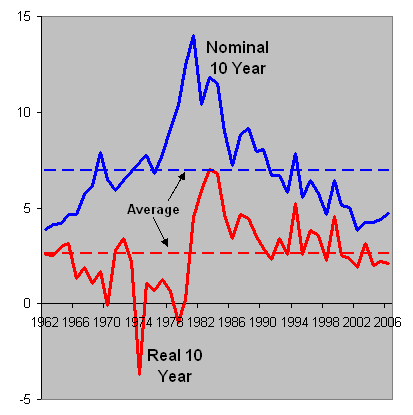
The blue line is the nominal 10-year Treasury. The dashed blue line is the average from 1962 to 2006. You can see we are well below the average (6.98% average vs. 4.70% today) in nominal terms. But take a look at the red line. There we've adjusted for inflation (by simply subtracting the year-over-year core CPI). There, the current rate of 2.60% is right in line with the long-term average (2.64%).
So what's the point. Well, let's look back at the original question. Are rates fundamentally too low? Looking at the chart above, and adjusting nominal rates for inflation, the answer appears to be no. But is it a worthwhile question to begin with?
The above analysis runs an average from 1962 to 2006 based on annual levels. What if we looked at the average for the last 20 years? The real-rate average would have been 3.04% and rates would have looked "too low" again. Which time period is relevant? If you can reach different conclusions by simply changing the time periods you are using, you really have to question the validity of the analysis.
Many times investors reach conclusions based on little more than a comparison of current levels versus historic levels. Even professionals. Look back at the nominal rate graph above. Most senior investment managers, particularly those operating at larger firms, have probably been in the business between 20 and 30 years. So when those people were starting their careers in the investment business, we were either in the middle of the worst bond bear market in modern history (1976-1984) or we were just coming out of it. From 1984 through 1994 rates were mostly at 7% or above. And the one time rates fell a good bit below that (1993), we were treated with a violent bear market in 1994. Then from 1995 to 1999, if you got bearish every time rates fell, you were rewarded. So really if you started your career in bonds anytime from the 1970's to the mid 1990's, you've been indoctrinated in the idea that when rates fall, they must subsequently rise.
So does this generalized view that rates are fundamentally too low stem from good analysis? Or is this really the equivalent of the theory in child psychology that personality is formed by age six. Maybe the types of markets you go through early in your career color your market views for the rest of your career.
Bottom line is this. Where markets have been doesn't say anything about where they are going. Interest rates are set by supply and demand for money. Supply and demand conditions in 1968 were different than 1983 or 1994 or 2002. So using these data points as a reference, with no other context, is a simplification of what is in fact, a complicated subject.
Thursday, May 10, 2007
I don't know how we're going to get out of this one
I've spilled a lot of virtual ink on the subject of LBO's since this blog began. I'd like to think that this space has been a pretty good source of commentary on LBO's in general as well as several specific deals/rumors from a bond holders perspective. Coverage of private equity activity in the mainstream media is at best, equity oriented. I'd go so far as to say that much of the coverage of private equity activity in the last year been more about vilification and less about economics. One sometimes gets the sense that the average financial journalist sees financial engineering as some sort of shell game. I think this attitude reveals more about the writer than about the subject matter.
Enough soapboxing. Let's talk about my favorite borrower: Alltel. Before we go any further, let me say that I am a holder of Alltel bonds through client portfolios, and I may buy more or sell the position at any time, regardless of the commentary herein. Let me further say that Alltel may be the second most risky A-rated bond in the world (after Sallie Mae, who's days as an A-rated company are very numbered.) Therefore anything I say here should not be considered as advice in regards to Alltel or any other bond. In fact, I'm probably just talking up my position and you should ignore me entirely. I'm channeling Bill Gross here. Plus if you are a retail buyer, you are going to get screwed over by your broker anyway if you try to take a position. So don't bother.
Yesterday, the Wall Street Journal reported some relatively concrete information on potential suitors for Alltel. This after many months of speculation rising and falling about a LBO for Alltel. My attitude toward rumors is this: the more specific the information offered by a respectable media source, the more likely its true. Of course, that doesn't mean Alltel will be bought out, it just means that when the Journal says Blackstone and others are working on a deal, I believe they are indeed working on it.
Now, I'm not a private equity analyst, but here are some difficulties I for see in any deal for Alltel.
- Alltel executives have said they want to keep debt to 7x cash flow. That would mean they could take on about $20 billion in debt in total, according to the Journal. That fits with "Cash Flow" being defined as operating plus investing cash flow. Alltel's current market cap is $22 billion, and they currently have $2.6 billion in long-term debt. So they can add about $17.4 billion in new debt. Let's assume the actually buy out price is $24 billion (~10% premium). That means that the buyer will have to put up $6.4 billion in equity cash.
- Let's say that they want a 20% IRR over 3 years. That's a 73% total return, or about $4.5 billion in dollars. They would have to sell Alltel in 3 years for $28.5 billion.
- What are the odds that Verizon or another strategic buyer would be interested in Alltel in 3 years and $6.5 billion more than today's price given that they are passing at today's price. In other words, if Verizon wants Alltel, they should buy them now. Waiting will certainly cost them more.
- I doubt very seriously that Alltel could do a new IPO at a price higher than today's price. It is widely believed that Alltel cannot survive long-term with their current business model. Other providers have tremendous scale advantages, and eventually, Alltel just won't be able to compete. Alltel has hung on because everyone knew that their customer base was valued by various other telecoms. In essence, there is a takeover premium in this company that does not reflect the basic business fundamentals. If the company goes private now, with all the telecoms passing, and chooses to go public in 3 years rather than sell to a telecom, that takeover premium has to disappear.
- Alltel only has about $7 billion in tangible assets on their balance sheet. In order for them to secure bank financing as a BB-rated credit, they will probably need to secure the debt with assets. But their current debt does not allow new debt to be secured ahead of old debt. That might mean that the private equity buyer also has to foot the bill for a bond tender, further increasing the price of the deal. On the other hand, this might play out much like First Data, as both companies had fairly small debt loads that could be tendered with a relatively small total cost.
I honestly think the most likely scenario would be that Alltel is bought by Verizon or Sprint. Either would be great for bond holders. Its possible that the LBO results in make whole calls, which would also be great for bond holders. Finally, its possible that nothing happens. That would be great for bond holders. By the way, their current spread equivalent to a BB-rated bond anyway. How bad can this get?
Wednesday, May 09, 2007
Thoughts on the Fed Announcement... such as it was...
Today's FOMC release was quite the snoozer. There was very little changed from the March statement.
- In today's statement, the FOMC said that "economic growth had slowed" which seems like a downgrade from "recent indicators have been mixed." But I read this as merely an acknowledgement of the meager 1Q GDP figure. They can't come out and talk about "indicators" when our most recent actual growth figure was sub 2%.
- However they used the exact phrase: "Nevertheless, the economy seems likely to expand at a moderate pace over coming quarters." I think using this exact phrase in both releases negates any perceived downgrade from the first sentence.
- The second paragraph on inflation is substantively the same. The only change seems to be cleaning up some wordiness. Nice to see the Fed cares about good grammar too.
- The final paragraph is exactly the same: "In these circumstances, the Committee's predominant policy concern remains the risk that inflation will fail to moderate as expected. Future policy adjustments will depend on the evolution of the outlook for both inflation and economic growth, as implied by incoming information."
I had read the March statement initially as dovish, but evidence from the actual minutes showed that I was wrong. The Fed is still worried about inflation, housing market be damned. Ultimately I still think their next move is a cut, but now its very hard to imagine that cut coming before December.
The curve should invert more, and we should test the -20bps 2-10 slope. I'd also see us testing the 10-year at 4.75%.
Monday, May 07, 2007
Could New Century Have Stopped?
When I bought my current house, I told my wife that it may take us several years to make good money from our investment. I reasoned that the housing market had moved so fast, interest rates were very low, and supposedly many borrowers were getting approved based on teaser rates. Rates were likely to rise and lending standards to strengthen, both of which would put pressure on the housing market, probably leading to a few years of near-zero real returns on housing. That was in 2001.
We all know I wasn't alone in worrying about the housing market years before problems started actually cropping up. Given this, why did mortgage lenders keep lending at a breakneck pace? After all, the senior managers at a mortgage lending firm have probably been in that business for a long time. They should know well the cyclical nature of the business, and also be well
aware that weak lending standards tend to lead to pain. Why not pare back your business and wait for better times? Particularly with sub-prime lenders. Why didn't they increase lending standards, even if that meant losing business in the short-run, believing that it would allow them to survive when the pendulum swung the other way?
The cynic would say they just tried to make as much as they could while times were good. The executives knew that stock and bond holders would wind up holding the bag, while they withdrew as much cash as possible. I'm not going to disagree with this view. But I don't want to turn this into a post about the principal/agent problem in public companies. That's a topic well
covered in other spots.
I'm here to say that mortgage lenders like New Century really couldn't have stopped making loans, no matter what their outlook was and no matter what their ethical tendency was.
First, consider what would have happened had New Century's management decided to severely cut back their lending? First, it depends when they decided to do this. What if they did it way back in 2001, when I was worried about housing? Or even 2002 or 2003? The management team would all be fired within a year or two, because sub-prime continued to perform extremely well, and New Century's stock would have dropped compared with competitors.
On top of that, New Century has warehouse loans and other liabilities. It is likely that getting out of those liabilities was impossible and/or very expensive. In addition, they had payroll. If they pared back lending, they'd wind up laying off large numbers of staff. But that would have meant that when things turned around, they wouldn't have the staff in place to take advantage of the turnaround.
Its no different than mutual fund managers who kept buying tech stocks in the late 1990's, while admitting they thought the shares were overvalued. Or, I suspect, bond managers buying high-yield today. Its very very very very hard for managers to walk away from their core business, no matter what their outlook.
Friday, May 04, 2007
Neglectful Blogger
I've been extremely busy this week and haven't had much time to devote to the blog. To all those that have made comments, there will be responses sometime this weekend if at all possible.
We've reinverted, as the 2-year is 3bps higher on the week, while the 10-year is 5bps lower. This is an interesting move, because its signalling that the Fed either will not cut or will hike rates, but this will eventually cause short-term rates to fall even further. Its kind of a bet on the 1999-2000 cycle repeating itself. As you remember, that ended in recession in 2001 and a deflation scare in 2002-2003.
I'm highly skeptical on this viewpoint. I think middle class consumers will cut back their spending to some degree over the next 2 years, at least as a percentage of their income. This should result in a lower velocity of money, causing inflation to subside. The Fed does not want to exacerbate the housing problem. Hiking short term rates further would do just that. It would be particularly damaging to sub-prime borrowers, who are more likely to have ARM mortgages, and therefore are directly impacted by rising short-term rates.
It is widely believed that the Fed was a major contributor to the housing bubble. The boom in sub-prime mortgage lending could never have happened without the extremely low short-term rates of 2002-2004. Today, the Fed knows that every 25bps it moves higher, there are that many more homeowners who won't be able to afford their reset. They can't ignore that fact. That doesn't mean they wouldn't hike if they needed to. But it does mean that they won't hike just to prove they have the kahunas to do it.
I also don't think we can ignore the Fed's role in the banking system. Sub-prime foreclosures are going to put some stress on some banks. The Fed doesn't want to add stress to an already stressful situation. Remember the last time we had a really bad housing market was during the S&L crisis. Now, it wasn't really home loans that got the S&L's into trouble, but the point is that a repeat of that kind of situation isn't out of the question in today's market. Why would the Fed increase the odds?
I really think this is a case where the Fed needs to see clear evidence of increasing inflation before they will hike further. If you really think inflation is on the horizon, the play is to assume short rates stay where they are for a little while, but longer rates rise.
Tuesday, May 01, 2007
Do Not Pass GO, Do Not Collect $200
In thinking about the inflation debate, I thought it illustrative to give an example based on something we all know and understand: Monopoly. Yes, the board game you've been playing your entire life. Some of the traders reading this probably made their first "rip his eyes out" trade playing Monopoly, and have been in love with ripping people off every since. By the way, I thought of this over the weekend, but I'm probably not the first to think of this allegory, so my apologies in advance if it appears I'm borrowing from someone else's work.
Anyway, in this example, let's imagine we are playing a simplified version of the game. We have three players who each get the standard allotment of cash ($1,500 each). Instead of rolling around the board, each property will be put up for auction at the onset of the game. What would we suppose is the average price paid per property?
If each player spends all of his/her available cash, then the average price paid (we'll call it the price level) is $160.71 ($1,500 times 3 players divided by 28 properties.) Now, its possible that some players choose not to spend all their cash, perhaps hoping to save some money for houses and hotels. This is in essence a savings rate. So if the initial cash position (which economists usually call an endowment) is $4,500 is M and the savings rate is S, and the number of available properties is Y, then the generalized formula for the price level P is.
P = M * (1-S) / Y
Anyway, back to our game. Assume all properties are now owned and each player saved exactly 10% of his/her original endowment. They all roll around the board in the normal manner, passing GO, picking up Chance cards, paying luxury tax, paying rent on properties they land on, etc.
After playing for 1 hour, the game ends, and a new game begins. Except the players get to keep all the cash they've accumulated to that point in the game, and this money is used to bid on all 28 properties at auction for the second game.
Now the money supply has changed hasn't it? Although by what amount depends on how many times people passed GO, won 2nd prize in a beauty contest, etc. If enough people landed on Income Tax or got a Pay School Tax card, M might even be lower. For simplicity, if we assume S is zero, then the percentage change in M equals the percentage change in P.
So if we define "inflation" as the percentage change in P, we can see that there cannot be inflation from game 1 to game 2 without an increase in M. Furthermore, if we keep playing games in the same manner, there cannot be persistent inflation over several games unless M increases persistently.
Of course, this isn't how inflation is calculated in the real world. It is actually estimated by selecting a basket of goods and measuring the price change in those goods. The equivalent would be to randomly select 10 properties and measure the change in price from one game to the next of those properties. We'd expect this to do a pretty good job of estimating inflation, but there would obviously be some noise.
Consider the possibility that we take the Illinois Avenue card and throw it out. Now you can't make a monopoly out of the red properties. That dramatically reduces the value of Kentucky and Indiana. But the impact on the price level is fairly small, because Y has decreased from 28 to 27. So if we started out with Y= 4,500 and S = 0, the change in price due to the removal of Illinois would be about +3.7%.
But Kentucky might have been one of the properties in the basket of 10 used to estimate inflation. Say Kentucky declines in value by 75% and the other 9 properties rise in value by 5%. The average price has fallen by 30%! But do we really have deflation? No, because in this case we can clearly see there was a change in preferences for Kentucky Avenue which has skewed the mean price change.
Simpler things could arise which create false inflation if you will. Suppose that early in the bidding process, one player has Atlantic and Ventnor Avenues, and Marvin Gardens comes up for the bid. That player can control the yellow monopoly if s/he can secure the last property. The other players do not want to allow the player to have a monopoly. So all three players bid
aggressively, and the price of Marvin Gardens winds up being extremely high. Here again, there was a change in value of this property. If Marvin Gardens had been one of the properties in the basket of 10, we would likely calculate some degree of inflation, when in fact, there was none. Whatever extra money was spent on Marvin Gardens isn't available to be spent on other properties. So the price of at least one other property must decline to offset the increase in the price of Marvin Gardens.
In the real world, we think less of an endowment and more of income. Consumers are paid in cash and this is what they use to purchase goods and services. Furthermore, the effective money supply isn't really fixed. Goods and services (as well as capital goods) can be bought on credit which has the effect of allowing for more transactions than what a strictly cash-based system would allow. So there is more that impacts the money supply than just how much cash the Fed is printing. But unless there is an increase in the money supply, there can't be generalized inflation.
Let's take the example of oil. Oil is a direct or indirect input in many consumer and producer goods. And virtually all consumers must regularly fill up their gas tanks. But how would an exogenous increase in oil prices affect inflation? Without an increase in the money supply, there can be no net impact. Let's go back to our Monopoly example. Say the first of the Railroads to come up for bid was Reading. And for whatever reason, Reading was bid more aggressively that in previous games. Does the price of Reading mean anything for the price of the other Railroads? Probably, because the players will have seen how aggressive the bidding was for one railroad and bid the others more aggressively as well. Here the Railroads are a bit like inputs into a finished good, because owning multiple railroads is more valuable than owning one. So the price of one impacts the price of others. Similar to how the price of oil impacts the price of finished goods that involve oil, such as gasoline, or services such as shipping or air travel.
But ultimately if there is no more money in the system, there can't be generalized inflation. If Monopoly players bid up the Railroads, they must bid less for other stuff. And if consumers spend more on air travel, they must spend less on something else.
The real debate should be how we can measure the money supply, and what economic events result in a change in the money supply. Now, what do I hear for New York Avenue?
Thursday, April 26, 2007
Please read this post...
... from Economist's View. It is a very good explanation of what inflation actually is and isn't from a monetary policy makers prospective. If you care at all about the Fed, read and understand.
Wednesday, April 25, 2007
Scott Ford to Wall Street Journal: Leave us alone
For the second time in the last 6 months, the Wall Street Journal is mongering rumors on Alltel. The first was that they would be taken private. Here was my take on that. Now they are to be bought by AT&T. We'll see. Both rumors appear to be based on nothing more than the imagination of a journalist.
Who's the more foolish? The fool, or the fool that follows him?
The corporate bond market continues to gather strength during April. After spreads gapped wider when the stock market melted down on 2/27, most investment grade corporate bonds have recovered their losses.
What happened in the corporate bond market in the days immediately following 2/27 and their subsequent recovery tells us a lot about what is driving corporate bond spreads. First an illustration. This graph shows the spread of three long-term, large issue corporate bonds. Goldman Sachs (rated Aa3/AA-), AT&T (A2/A), and Comcast (Baa2/BBB+). Since none of these three have had particularly good or bad news lately, they are all good examples of where corporates in general are moving. I did a basic normalization of all three by starting their spread at 100 and moving it up or down from there. So any point where any of the blue lines are below 100 (dashed horizontal line), the spread tightened from its initial 2007 level. The red line is the VIX, which I'll get to in a minute. The vertical dashed line is the 2/27 mini-crash.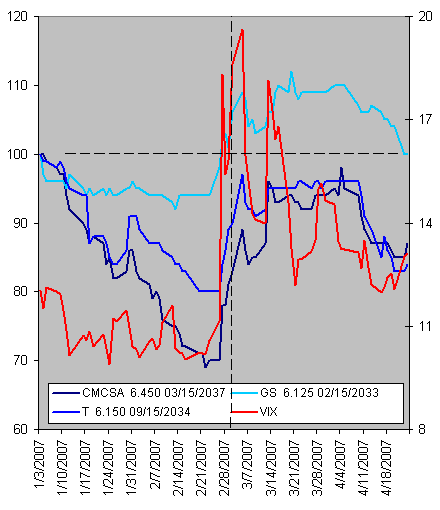
First, let's agree on three basic premises.
- Most traditional money managers are negative on the corporate basis, and have been for some time. Many (if not most) are looking for some catalyst that will push corporate spreads wider.
- Hedge funds and other speculative investors are the marginal buyer or seller of credit risk on any given day. Many hedge funds use quantitative models in building arbitrage strategies involving the corporate bond market. The VIX (or some similar measure) is a very common input in such models. Hedge funds are also involved in paired trades where one is long or short the stock and the opposite of the bond.
- There remains a tremendous level of global liquidity.
So why would hedge funds be buyer protection aggressively in the face of a 400 point drop in the Dow? It sounds like a silly question, because obviously if the Dow is dropping like that, there is some kind of repricing of risk going on. But consider what happened since 2/27. By March 21, the Dow had recovered more than half of its losses from 2/27. But these three corporate bonds did not start tightening meaningfully until mid-April. Today, the Dow is over 220 points higher than its pre-2/27 high. Our selection of corporate bonds are all still wider than before the 2/27 rout.
So those that would chalk the whole thing up to risk repricing must suppose that the stock market and the bond market have divergent opinions of the same set of economic fundamentals. Maybe, but I don't think Occam would approve. What if it isn't really fundamental? If it were entirely technical, then it isn't hard to imagine that the corporate and equity markets would go in different directions because they're subject to different technicals.
Back to the three premises. If portfolio managers are generally negative on corporate spreads, they are likely to view a sell-off as lasting. Let's face it, most people's reaction to market events is biased by their positions. So they don't buy on the dip, not right away, because they see it continuing. They probably don't sell what positions they do have either. They are already short of their benchmarks and are loathe to deviate too much. On the other hand, equity PMs aren't necessarily as bearish. So maybe they are more aggressive about buying on the dip. Still, this doesn't explain why the rally in mid-April. If PMs aren't doing anything, then corporate spreads would be hanging wider.
Meanwhile, there is still this ocean of liquidity. Cash will be invested someplace. But this massive liquidity doesn't come into the market on any given day. It just sits there, buying up a certain amount of bonds each day. So while the liquidity might explain why corporates didn't get even wider, I don't think it explains the delayed rally. It isn't like the liquidity showed up in mid-April after sunning in Florida during March.
So we're back to speculators driving the market. Why would they change their minds on corporate risk so quickly but at the same time, not change their minds concurrent with the stock market rally?
My bet is that some fast money is following the VIX. Look back at my graph. The VIX spikes higher from 11 to 18 on 2/27, corporates sell off. The VIX stays high until the end of March, averaging 15.5 for the next 20 trading days, corporate spreads stay high. The VIX falls lower at the end of March (its averaged 12.9 in April), and corporate spreads get a little better. But the VIX is still well above its recent low of 9.9, just as corporates spreads remain above their recent tights.
Now, I don't know of any quantitative spread model that doesn't involve the VIX, or some other measure of stock volatility. The theory is that higher VIX levels indicate economic uncertainty, which is bad for corporate bonds. So your model says sell corporates as the VIX is rising, and buy corporates as its falling. But looking at this graph, doesn't it look like these traders got whipsawed? If you add to this that CDS were even more volatile than bonds over this period, its likely that some traders really got whipsawed.
I am not here to bury quantitative models. I use them myself constantly. But I think one needs to be careful when using a measure of the market's emotional state as an input into a quant model. The market is manic-depressive. Guessing that today's mood is an indicator of tomorrow's mood is dangerous. So if any trader did get whipsawed trying to trade the VIX while ignoring the economics around him, it isn't the model that's the fool. Its the fool that followed the model.
Tuesday, April 24, 2007
Globalization and Monetary Policy
Macroblog has a post today titled "Does Globalization make Monetary Policy Harder?"
I think the answer is yes, but not because of the issues brought up on the article. On the site, I made the following comment:
I think the globalization impact on monetary policy has more to do with capital flows. Take for example Japan. It appears low interest rates in Japan have resulted in capital outflows without influencing consumer spending. Whether you are a monetarist or Keynesian, consumers have to spend more currency in order for prices to rise. If shifts in interest rates result in capital flows and not consumer activity, the ability to influence consumer prices is diminished.
In addition...
- Globalization may be influencing wage levels more directly than goods prices. If wages don't grow (in nominal terms) you can't have inflation. In order for the aggregate price level to rise, consumers have to actually spend more. That requires either wages to rise or the savings rate to decline. If we agree that the savings rate will have a hard time declining in the U.S., we need wage growth to have inflation.
- Rampant use of U.S. dollars for purposes other than U.S. consumption is influencing the U.S. money supply. I'm particularly thinking of flows from immigrants to foreign persons (i.e., sending dollars home that get spent in the foreign country), as well cash held to support dollar pegs.
Anyway, those are my thoughts. I think the net consequence of this is that monetary policy takes bigger swings than it did in the past, and that fighting deflation will be harder than fighting inflation.
Sunday, April 22, 2007
How does a Credit Default Swap (CDS) Work?
Credit Default Swaps (CDS) are fast becoming the dominant vehicle for trading credit risk. In this piece, I'll go over the basic features of a standard CDS contract and why they are easier for many traders to utilize over cash bonds.
At the onset of a CDS contract, the buyer of the contract agrees to pay a fixed spread to the seller of the contract. For corporate CDS, the spread is paid quarterly, so if the spread agreed to is 40bps, the seller would pay 10bps per quarter. In exchange, the seller agrees to buy a specified bond (or other instrument) from the buyer at par in the event of a default. Most CDS contracts have a five-year term, but other terms are possible. If CDS are quoted without a term specified, assume its five years.
A CDS is a lot like an insurance policy. This is why CDS are also called protection. The spread paid by the buyer is like the insurance premium. If there is a default, the buyer is essentially made whole because s/he gets par for the bonds. Just like if you have homeowners insurance and you have a fire, the insurance policy pays you whatever your stuff is worth.
The CDS contract references a specific bond (or bank loan). For example, the 5-year Alltel CDS references the AT 7% '12. In the event of a default, the seller will be buying some bond which is pari-passu with the reference bond. The buyer of protection doesn't have to actually own this bond. In fact, the buyer of Alltel protection might be a bank with which Alltel has a credit line. The bank knows that if Alltel gets into trouble that the credit line will be drawn down. But they also know that the CDS contract spread will widen substantially, and they will have a profit in the contract. If Alltel actually defaults, they can buy the bond in the secondary market at a steep discount, then sell it to the seller of protection at par and make a huge profit.
CDS are also a vehicle for speculating on a credit. The buyer of protection is essentially short the credit, while the seller is long. Buying protection may be easier than actually finding the bonds to short. Similarly, selling protection may allow one to get exposure to a credit with greater leverage than would otherwise be the case. CDS also have no interest rate exposure, so someone who wants get get long or short a credit can do so without needing to work about hedging credit risk on either the short or long side.
In fact, selling CDS protection in consort with owning a LIBOR floating asset is exactly like being long a 5-year FRN (if you ignore things like financing costs). Think about it, with the 5-year FRN, you'd get paid LIBOR plus some spread so long as the credit doesn't default. If it does default, you suffer the difference between par and the recovery rate. The CDS/LIBOR combination has exactly the same payout structure. For that matter, selling protection is also very much like buying a 5-year fixed corporate and heding with a 5-year LIBOR swap. You wind up just collecting the spread. For this reason, the CDS should have a similar spread as cash bonds when compared to LIBOR swaps.
In practice, CDS can divert from cash bonds materially for a couple reasons. First, the CDS may be deeper than the cash bonds, and in a fast moving market, the CDS may appear to lead cash bonds. In reality, this may be that the cash bonds aren't trading. More recently, we've seen CDS widen in LBO situations while the cash bonds tighten. This is normally because of covenants in the cash bonds which will result in a make-whole call. This post on the Equity Office Properties transaction describes this possibility in more detail. The same thing happened recently with First Data Corp's LBO. Even with companies rumored, like Alltel, to be possible LBO candidates and have attractive covenants, the CDS tend to under perform cash bonds.
Another reason is a cute little arbitrage involving discount priced bonds. Take Ryland 5.375% '15. This bond was issued in January of 2005 when the 10-year was 50bps lower, and troubles in the housing market has pushed the spread about 75bps wider. As a result, this bond has a dollar price of $92. So let's say I buy the bond and buy protection on it. If it defaults, I get paid par for my bond. I make 8 points. If it doesn't default, and the carry isn't negative, nothing happens. I get paid the yield on the bond, but probably gave up all the spread buying the CDS. So basically its a trade that has a high probability of doing nothing, but a small possibility of producing a nice return. Upside with no downside = arbitrage. Anyway, so CDS that reference discount priced bonds tend to be wider than those referencing premium priced bonds.
Feel free to comment if you have questions, or e-mail me at accruedint AT gmail.com.
Thursday, April 19, 2007
More on Sallie Mae
First a correction. Tuesday I claimed that Sallie Mae's leverage would decrease because of contributed equity. If I had actually thought about what I was saying for a minute I would have realized that's not right. As an Anonymous commenter pointed out, the company is being purchased for $25 billion, so all that purchase cash is going out the door. That includes the $8.5 billion in equity contributed. So debt increases by $16.5 billion and leverage increases accordingly.
Commenter mOOm asked whether equity goes negative here, since the company only had around $4 billion before the transaction and if they increase liabilities by $16.5 billion, but decrease cash asset by $25 billion, that'd seem like negative equity. I think the way the accounting of this works is that the premium paid for the company over book value goes in as a credit to goodwill. My knowledge of merger accounting is limited to the CFA exam 6 years ago, so I could be rusty on this. Anyone who knows this better than I is encouraged to leave a comment. Now, mOOm's may ultimately be right in a way, since goodwill is an intangible asset anyway. I tend to use interest coverage ratios of various types when analyzing a company's leverage anyway, since the "real" value of a company's assets is always questionable.
Now on to the merger itself. That's right, I'm calling it a merger. Because this does not walk or talk like your typical financial engineering-type LBO. By extending a huge credit line to Sallie Mae, JP Morgan and Bank of America are acting more like strategic buyers. Think about it, Sallie currently has $112 billion in debt outstanding. Would these two banks, in the normal course of business, extend a $200 billion credit line to a company like Sallie? I seriously doubt it. They are only doing so because they have a strategic interest in the company. I think what JP Morgan and Bank of America are doing here is trying to better tap the large student loan market. They realized they couldn't do it organically, and they didn't want to buy up SLM themselves and suffer the drastic increase in leverage on their own balance sheets.
So they get JC Flowers and Friedman Fleischer & Lowe together and buy SLM jointly. The two banks essentially benefit from the fee income stream of Sallie's student loan business, but keep the whole thing off balance sheet. GAAP accounting (and bank regulators) will not consider SLM's debt load as part of either bank because its theoretically non-recourse. De facto, the credit line changes the recourse story entirely. If SLM struggles with all that leverage, they'll take down the credit line and JP Morgan and Bank of America will be holding the bag. Again, this smells a lot more like a strategic merger than a typical LBO.
But this is a bond blog not a private equity blog. So let's talk credit ratings. I've heard different theories. One is that SLM will wind up going to a B-rating. Ugly. Under that scenario, they can get away with the low rating by simply securitizing everything. Here's what I don't get about that theory. Once they securitize the student loans, there is no liability or asset on their books. They've simply collected a fee and then sold off the risk to someone else. They may retain a servicing fee (I'm assuming, I don't know much about student loan securitization), but student loans are floating, so there isn't the same hedging risk that mortgage servicers face. But in that scenario, I'm not sure why they'd suffer a big credit downgrade. I mean, they'd simply be transitioning from a S&L type model (borrow at X, lend at X+200bps), to a conduit model (collect fee for facilitating the loan, then sell the risk to the public). One isn't necessarily more risky than the other. Obviously there could be more to the plan, I'm just saying, altering their core financial strategy doesn't automatically mean they should have a weaker rating.
Another theory for a junk-rating is that their current debt is subordinated to the new debt. To me, whether that justifies a junk rating or not depends on how much of that credit line they've tapped. Typically, subordinated debt is notched from the senior debt. If the credit line isn't used at all, there is going to be a small amount of secured debt and a large amount of unsecured debt. I think in the absence of the credit line, the ratings agencies would simply notch the old debt one notch, maybe two. The company has $96 billion in student loans, so to secure $16.5 billion doesn't put the old loans in such bad shape. Obviously if SLM takes down $100 billion of the credit line, then that's all out the window. But why would they do that right off the bat? And I don't think the rating agencies will rate the company's leverage based on the credit lines they might use. If they did that, then why not rate every company on the bonds they might sell to the public at any time? I think they will only consider the credit line to the extent that the company says they intend to use it.
So I could be wrong about all this, but my read on this is that the credit downgrade won't be as bad as what's priced in right now. There is current a rush to the exit, as a downgrade to junk would cause massive forced selling. Again, I could be wrong, but I think patience will be rewarded here.
Tuesday, April 17, 2007
How I go into College or the SLM LBO...
In case you are living under a rock, Sallie Mae is to be taken private by four investors. SLM Corp., which is their less known official name, might just be the most prominent investment-grade bond issuer to be taken private. While SLM is not a major component of the Lehman Aggregate, they are a major issuer of floating-rate notes (FRN). As such, I'd suspect this transaction will touch certain investors not used to dealing with this kind of corporate event risk.
SLM's bonds have widened substantially. FRNs in the 5-year range were trading around LIBOR +25ish, now more like +120. Its an extremely volatile market, and so the spread is changing as I'm typing this. A 100bps move on a 5-year bond is about 3 points.
I'm very surprised by this transaction. Although SLM has come up before in LBO talks, I didn't believe the company could withstand a large increase in leverage. But upon looking at what little detail has been made public so far, the buyout is gong to be funded with $16.5 billion in debt and $8.5 billion in equity. Looking at SLM's balance sheet, they currently have $112 billion in debt versus $4 billion in equity. So after the transaction, they'd have $128 billion in debt versus $12 billion in equity? That's a decrease in leverage from 28x to 10.7x.
It also occurs to me that the backup financing that JP Morgan and Bank of America are providing may be to help ensure an investment-grade rating, not as has been reported, to protect against the possibility of a junk rating. Consider that if BofA and Morgan thought the company would be junk rated, then the credit line would immediately be used. That makes the credit line de facto equity contributed to the deal, and would greatly decrease the IRR on the transaction.
On the other hand, if the ratings agencies see that there is a large, untapped credit line, the risk of a sudden bankruptcy greatly diminishes. In fact, the credit line is nearly 2x their entire loan portfolio. The ratings agencies should allow for greater leverage when the company has ample liquidity available to them.
With any private transaction, the devil is in the details, and we haven't seen too many of those yet. My quick take is that SLM winds up getting downgraded into the Baa/BBB range, but no further. That should allow the bond spreads to tighten from here.
Friday, April 13, 2007
You were right David... Tell your sister, you were right...
Both my and the market's reaction to the initial Fed release on March 21 were wrong. It sounded to me like the Fed made a fundamental shift in their rate strategy when they dropped the phrase "additional firming... may be needed" from their statement. Logically, if the Fed saw the need for a cut in the near future, they'd start by dropping that phrase.
Reading the actual minutes, released on Wednesday, you don't get the same impression. It sounds more like the Fed sees some increased risks to the downside, but also sees stubbornly high inflation indicators. Reading between the lines, I think the Fed wanted to acknowledge their willingness to cut rates if it indeed comes to that, but we aren't there yet. Conversely we could say the Fed wanted to let the housing bears (and member banks) know that they aren't ignoring the housing situation, particularly the growing sub-prime problem. If a little boost to liquidity would help, then they may well oblige. But we aren't there yet.
So while I was wrong, kudos to people like David Andrew Taylor who were right. David posted on his blog right after the release that he still read the Fed as hawkish. I was proud of myself for getting the initial market reaction right, but it looks like that was merely the initial skirmish. David won the war.
In terms of actual trades, this was a case where I may have been wrong, but still made money doing it. I had moved my duration slightly lower in the last week of March. Rates have risen between 10bps since then. I'm positioned for a steepener, and even though we've flattened from +6 (2-10) on 4/2 to +1 now, the bigger picture is the move from -19bps in November to +1 now. I'm also long financials, which have outperformed considerably the last 5 days. MBS are also having a solid month of April so far.
Most of my bets play out well in a low volatility environment, so the Fed on hold scenario is just fine by me. I also think the 10-year has to rise more from here, with no move from the Fed, I've got to think the 10-year moves toward 5.25% by year-end. Whether it gets there or not depends on whether some of the housing headlines calm down and whether inflation figures allow the Fed to remain on hold. If it develops where they could actually hike, then the curve re-inverts in a bearish fashion.
But taking everything on balance, I still like the Fed to cut twice by year-end. I think that inflation will indeed subside. At that point, the Fed can turn their eyes to the banking system, and will conclude that 50bps of cuts will take a lot of sub-prime related pressure off. If I'm right about that, I think the 2-year stays right where it is and the 10-year sells off to 4.90%.
If you read this post from the afore mentioned David Andrew Taylor, he makes a logical case for rising consumer spending from here, which would normally create inflation pressure. I believe monetary policy is no longer accommodative, and I think consumer credit conditions have tightened. Both of these should be disinflationary, and I think this is what will win the day. David is taking a Keynesian approach, while I'm walking down Milton Friedman's path. We'll see who is right.


